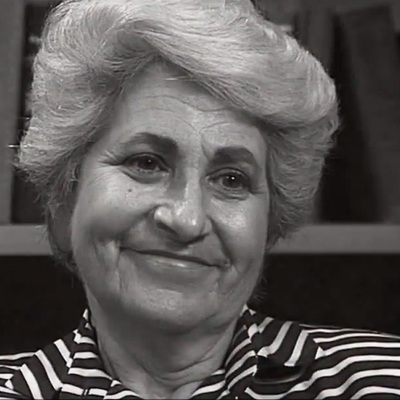
Interviewer: Okay. This is an interview with Rosemary Arnold by Miriam Bassok. It’s part of a Holocaust project, giving us the chance to record in person a survivor’s account of her experiences. What is your full name?
Rosemary May: My full name is Rosemary Suzanne Cremer May Arnold.
Interviewer: When and where were you born?
Rosemary May: I was born February 6, 1929, in Neuwied on the Rhine, Germany.
Interviewer: What was your father's name?
Rosemary May: Friedrich—called Fritz—Cremer.
Interviewer: And your mother’s maiden name?
Rosemary May: Caroline Theodora, called Tea, maiden name Bea.
Interviewer: What do you remember about life before the war?
Rosemary May: I remember being excluded as a child—Jews were not allowed in public school, stores, movie houses, or the swimming pool. I had to attend a makeshift Jewish school taught by the synagogue’s religious teacher. My formal education ended after third grade.
Interviewer: What happened on Kristallnacht?
Rosemary May: On November 9, 1938, my father was arrested at 2 a.m. and taken to Dachau. Our business was destroyed, then our home. Everything—china, crystal, books—was thrown out the windows. My father came back two weeks later, a changed man. He was ordered to leave Germany by January 1, 1939.
Interviewer: What happened next?
Rosemary May: My father fled to Holland. Soon after, my brother and I followed and were placed in a camp in a nunnery in Rotterdam. We were trying to get to America, but Germany invaded Holland on May 10, 1940—the same day we were to receive our visas. Afterward, the Germans built the Dutch concentration camp Westerbork, and we were sent there to help construct it.
Interviewer: What was life in Westerbork like?
Rosemary May: We lived under Jewish-run internal administration. I worked on the transports—standing at the trains with a clipboard, checking off hundreds of people being loaded into cattle cars bound for “labor camps,” which were really Auschwitz. I witnessed constant fear, chaos, and families being torn apart.
Interviewer: You met Anne Frank there, correct?
Rosemary May: Yes. I met Anne Frank at Westerbork. We were the same age and became friends for three days before her transport left for Auschwitz.
Interviewer: When were you sent to Theresienstadt?
Rosemary May: In January 1944. Conditions were much worse. We lived in attics on straw mattresses full of lice and bedbugs. Sanitation was terrible—one cold shower a month and troughs used as sinks. We received bread made mostly of rotten potatoes and bugs, plus thin cabbage soup.
Interviewer: You nearly were sent to Auschwitz?
Rosemary May: Twice I was put on transports out of Theresienstadt. Twice I was pulled off at the last moment due to my work in the tailoring shop and mica-splitting detail. Later, I discovered that the young people on those transports were used for medical experiments. It was divine intervention that saved my life.
Interviewer: What did you witness as the war went on?
Rosemary May: By 1945, transports arrived from other camps—skeletal survivors, barely alive. After my full workday, I nursed these prisoners the best I could, though there was no medicine or food. That’s when we first learned about gas chambers and mass burials.
Interviewer: What was Theresienstadt like during Red Cross inspections?
Rosemary May: It was a show camp. A complete façade. They staged concerts and set up “shops,” issued fake Theresienstadt money, and hid the sick and starving. The Red Cross saw an illusion.
Interviewer: Did you see both good and bad in people?
Rosemary May: Absolutely. Some people stole food, informed on fellow prisoners, or acted out of selfishness. Others risked their lives to help. I became skilled at stealing potatoes or scraps for my mother—always dangerous. Some inmates protected epileptic prisoners by creating distractions during seizures. I saw the full spectrum of human nature.
Interviewer: How were you liberated?
Rosemary May: We were to be annihilated the very day the Russians liberated us. Afterward, we tried to return to Holland. The Dutch initially refused us entry, but I insisted I would die on the tracks before returning to Germany. They finally let us in.
Interviewer: What was life after the war?
Rosemary May: I lived in Holland until 1947, worked cleaning houses, mending clothes, then became an assistant designer in a factory. I emigrated to the U.S., first to Chicago, then Nashville after marriage.
Interviewer: How did your experiences affect you?
Rosemary May: I was fearful for many years, withdrawn, insecure, afraid to trust people. My children absorbed some of that. I have dreams whenever I speak about the Holocaust. Yet I rebuilt my life through faith, resilience, and community.
Interviewer: What is your message to future generations?
Rosemary May: We cannot afford to forget. Not for the horror, but for the lessons. We must care for each other—every religion, every race—so it cannot happen again. If even one young person hears my story and chooses compassion, then I have succeeded.