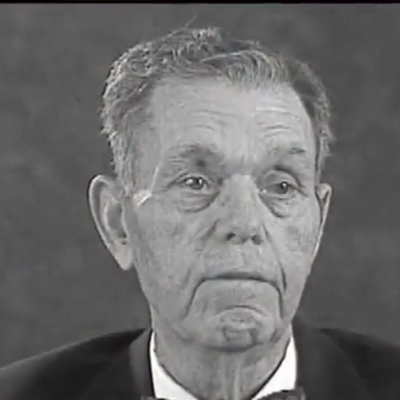
Interviewer: John Lassing. It’s May 20, 1990. We’re at the Jewish Temple. John—for the record, for the tape—what is your full name?
John Lassing: John Morris Lassing Jr.
Interviewer: And what is your address?
John Lassing: 116 Laird Road.
Interviewer: Your telephone number is 352-6371.
John Lassing: Yes, it is.
Interviewer: Your birth date?
John Lassing: April 24, 1925.
Interviewer: You and your wife and all of your children have all been born in Nashville?
John Lassing: In Davidson County. Yes.
Interviewer: And your parents ahead of you?
John Lassing: Yes.
Interviewer: Your ethnic background?
John Lassing: Scots-Irish.
Interviewer: A little bit of German…
John Lassing: Methodist. A little bit of German, Methodist.
Interviewer: What was your father’s occupation?
John Lassing: He was an oil distributor.
Interviewer: And your mother?
John Lassing: Housewife.
Interviewer: What did you do before 1941?
John Lassing: Student.
Interviewer: You were born in 1925, you said, in Nashville, so you were a student. Do you remember what grade you were in when the war broke out?
John Lassing: Yeah. I remember very well when they bombed Pearl Harbor. I was a senior at the Columbia Military Academy.
Interviewer: So that was a prep school down in Columbia, Tennessee.
John Lassing: Hmm-hmm. Forty-three miles south of Nashville.
Interviewer: You were getting a kind of military training?
John Lassing: Yes. My father believed that we might get in the war England was already involved in. He thought it’d be best for me to go to ROTC military school and get training, and then maybe when the war did come I would be able to get a commission. Which didn’t pan out, but that’s not a problem.
Interviewer: You must be like me. I was in Georgia and we only had 11 grades then. Was that true then? Did you have 11 or 12?
John Lassing: We had 12.
Interviewer: You did?
John Lassing: But I had made up one early in my school career.
Interviewer: So you were graduating…
John Lassing: I did graduate after Pearl Harbor in June. Pearl Harbor was in December. I graduated the following June.
Interviewer: So you were 17?
John Lassing: Right.
Interviewer: When did you join the Army?
John Lassing: The next year. I came home and worked in my dad’s plant and we had the draft. I volunteered to be drafted early.
Interviewer: Would you clarify that? You volunteered rather than were actually called?
John Lassing: Right. We knew some of us would be drafted in September. A friend and I thought we might get ahead of the hound if we went to the draft board and said, “Take us now and let us get our chance to do some of the things we want to do.”
Interviewer: Where were you sent for training?
John Lassing: I was inducted at Fort Oglethorpe next to Chattanooga. Came back home for nine days, then went to Camp Shelby in Hattiesburg, Mississippi, for basic training. After that I went to Augusta, Georgia—Camp Gordon. Later, I was sent to Fort Bragg, North Carolina, then to Camp Gilmore, New Jersey, to go to Europe.
Interviewer: At Camp Gordon, what were you being trained to do?
John Lassing: Be cannon fodder. Infantryman.
Interviewer: And then?
John Lassing: At Fort Bragg they gave me some medical training. I didn’t know why at the time. Then in England I got more medical training. When we finally went to Europe, I was a medic.
Interviewer: What Army unit were you a part of?
John Lassing: I was in the 79th Infantry Division when I went overseas, but within two days on the coast I was detached and attached to the 2nd Armored Division because the tanks were moving so fast the infantry couldn’t keep up.
Interviewer: Which coast?
John Lassing: Omaha Beach.
Interviewer: You’re talking about after D-Day.
John Lassing: I’m talking about sometime after 1:00 p.m. on D-Day. The Navy dropped the ramp, but the water was shoulder high. They were shooting at us. I pulled a boy out of the ocean as I went up on the beach.
Interviewer: So you went into France on June 6, 1944?
John Lassing: The sixth or seventh wave.
Interviewer: And you went in as infantry?
John Lassing: 79th Division.
Interviewer: But then you were reassigned to 2nd Armored?
John Lassing: Yes. I carried the first casualty I picked up to the little cemetery on Omaha Beach for burial. We moved inland by nightfall.
Interviewer: Why didn’t you have a gun?
John Lassing: Medics were not allowed to carry guns.
Interviewer: When were you formally assigned as a medic?
John Lassing: March 1944.
Interviewer: Did you save people on the beach?
John Lassing: Yes. We pulled them up and got them out of the water.
Interviewer: You were a combat medic?
John Lassing: That’s basically what I was.
Interviewer: Tell us about the next months, from June ’44 onward.
John Lassing: There were pockets of fighting but no huge battles until the Hürtgen Forest. We moved east toward Germany. The 2nd Armored was pulled out and later sent back into the line. After crossing the Rhine at Mannheim, it was clear the German Army had lost its zeal. But the SS pockets fought hard.
Interviewer: Had you seen horrible things before Dachau?
John Lassing: Yes. My partner and I picked up a man with both legs and both arms blown off. I tried to pump blood into him directly from my arm. No way to save him. But he was there of his own free will, fighting for freedom. Others I saw later in the camps were not there willingly.
Interviewer: You were hardened by battle?
John Lassing: Yes. Nothing tender about me by then.
Interviewer: But nothing prepared you for Dachau?
John Lassing: Oh, no. Nothing.
Interviewer: Tell us how you got to Dachau.
John Lassing: After the Bulge and more fighting, we advanced toward Munich from the southwest. We got mixed up on the roads—maybe signs were changed—and ended up at Dachau instead. We took the town easily. Then someone got wind of the camp.
Interviewer: And you went to the camp?
John Lassing: Yes. We got machine pistol fire from the guardhouse. The SS guards wouldn’t surrender. We overpowered them. A shout for medics went out and that’s how I got inside.
Interviewer: What did you see?
John Lassing: A railroad siding with 28 gondola cars filled with dead bodies. A man crawled up to me, starving. I gave him a chocolate bar. He wolfed it down and threw it up—it was too much for him. There were bodies everywhere—some alive, some dying, some dead. The smell was overwhelming.
Interviewer: How long were you at Dachau?
John Lassing: Eight or nine days. We treated starvation, illness, gave shots, fed them carefully. Many were too weak to react to anything except food.
Interviewer: Did you ever forget it?
John Lassing: Never.
Interviewer: How did it affect you?
John Lassing: It shattered my belief that all people are good. It proved some are not.
Interviewer: Did you talk about it when you came home?
John Lassing: No. I couldn’t talk about any of it for years. Not until my wife found my photos and asked.
Interviewer: You know it’s important to tell?
John Lassing: Very definitely. We should never allow this to happen again.
Interviewer: Thank you for doing this.
John Lassing: You’re welcome. I hope I’ve given you something you can use.