Interviewer: You were in the ghetto? You were in a camp?
Freda Weinreich: Yeah.
Interviewer: We’ll talk a little bit about the camps and the ghetto, then we’re going to talk about liberation and then we’re going to talk about what brought you to Tennessee.
Freda Weinreich: OK.
Interviewer: Feel free to stop at anytime. Feel free to take all the time you need.
Freda Weinreich: OK.
Interviewer: And I’ll just ask you a couple of questions.
Freda Weinreich: All right.
Interviewer: Anything you want me to know, you feel free to… you don’t have to only wait to be asked, you can offer anything. But let’s just start by telling me a little bit about your family and what you remember growing up in Poland before the war.
Freda Weinreich: We lived in Łódź, Poland, the second largest city. I was 15 when the war started. I attended public school. My parents were very pious. We were not well-off, but lived moderately. I had five siblings—three sisters and two brothers. Nobody survived. We lived a normal life before the war.
Freda Weinreich: In 1937 our school principal, who was from Austria, visited home and came back warning us about Hitler. When the war talk began in 1939, my mother cried, remembering World War I. But this war was different—it was a war against Jews. When the Germans came into Łódź, they immediately rounded up Jews for forced labor and beatings. Schools were closed to Jewish children.
Interviewer: Tell me about your early memories of antisemitism.
Freda Weinreich: Personally, I didn’t experience much directly. But Poland was very antisemitic, especially because the church preached antisemitism. During Easter, Jews stayed out of the way. I attended Jewish public schools—Jews and gentiles were separated. So I didn’t encounter much personally.
Interviewer: Tell me about the invasion.
Freda Weinreich: On September 1, 1939, we heard the war had started. By September 3rd, the Germans reached Łódź. Poland was unprepared. The Germans burned synagogues within weeks. By December, they were already discussing the ghetto. On May 1, 1940, the Łódź ghetto was closed. We were in the ghetto for four and a half years.
Interviewer: Tell me about life in the ghetto.
Freda Weinreich: It was cramped, cold, and full of hunger. There was no coal for heat. Factories were organized for work. I made straw shoes for soldiers fighting in Russia. Food was scarce—we received a quarter loaf of bread for a whole week. People starved. My father died of hunger in 1941. Children died, adults died. I survived partly because I had some weight at the beginning.
Interviewer: Were there any Shabbat services or education?
Freda Weinreich: Not openly. Everything had to be secret. We watched for Germans. Some lost faith, some didn’t. My family never lost faith. We celebrated holidays as much as possible. We never ate bread on Passover.
Interviewer: You stayed in the ghetto until 1944. What happened then?
Freda Weinreich: They began liquidating the ghetto. They said we were being moved to another ghetto. There were selections all the time. My mother once appeared on a list to be deported, but I begged a factory official to remove her name—and he did.
Freda Weinreich: Eventually we could no longer hide. We went to a transport. They told us to take bread and belongings. We arrived in Auschwitz in the middle of the night. Men to one side, women to another. My mother was sent with a neighbor and her baby—straight to the crematorium. I begged to go with them, but prisoners dragged me away. That saved my life.
Interviewer: What were those first hours in Auschwitz like?
Freda Weinreich: Terrifying. Prisoners with shaved heads screamed for our bread. We thought they looked insane. We were shaved, undressed, given ill-fitting clothes, and kept in overcrowded bunks. We received one bowl of soup per five people. I was in Auschwitz for three days before being sent to a labor camp.
Interviewer: Were you tattooed?
Freda Weinreich: No—they gave us dog tags. Too many transports were arriving.
Interviewer: What happened next?
Freda Weinreich: We were sent to Kristianstadt in Germany. A thousand girls were already there. Conditions were harsh. I was selected for bricklaying. We worked long hours. People grew sick—some had convulsions from something in the food. There was even a woman who smuggled a pregnancy past Mengele and delivered a baby in the camp, hidden in the infirmary.
Freda Weinreich: In late 1944 I was punished for picking up a potato and later put on a list of 20 girls sent to another camp—Parschnitz, in Czechoslovakia. We wore coats marked with yellow crosses so we couldn't escape. Germans threw bread to us like animals.
Interviewer: Tell me about liberation.
Freda Weinreich: Parschnitz was liberated by the Russians on May 9, 1945, the day after Germany surrendered. The Germans fled when they heard the Russians were coming. We were overwhelmed—we couldn’t believe we had survived. Many died after liberation because they were too sick to handle regular food.
Interviewer: What kept you alive?
Freda Weinreich: I don’t know. Maybe youth. Maybe luck.
Interviewer: What do you want people to know?
Freda Weinreich: People can be very cruel. If we forget, it can happen again. If it happened in cultured Germany, it can happen anywhere. Ordinary neighbors helped the Nazis—especially in Poland. Some helped Jews, but most didn’t.
Interviewer: What brought you to Memphis?
Freda Weinreich: After the war I met my husband Sam in a DP camp. We wanted to go to Israel, but a friend encouraged us to register for U.S. immigration. We were assigned to Memphis because my husband was a furniture finisher and there was work here. We didn’t even know where Memphis was—we found it on a map. We arrived at night, exhausted and excited.
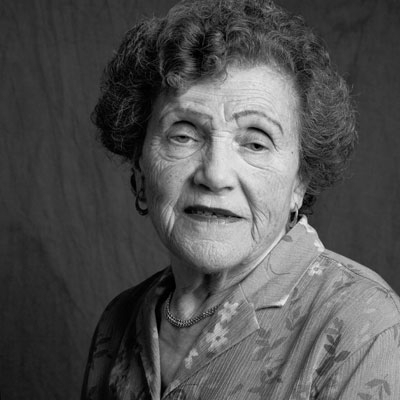
Interviewer: Thank you. Paul is going to take your portrait now.