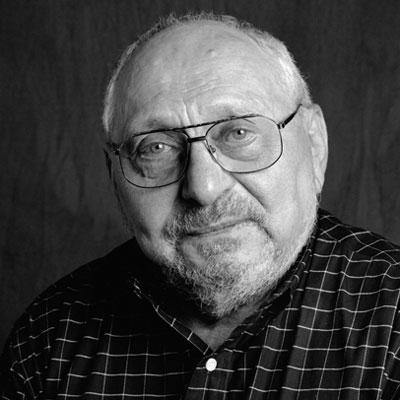
Interviewer: You grew up in Lithuania?
Arthur Pais: Yes, I was born and raised in a town called Vilkomir in Lithuania, and I’m not really supposed to be here, because everybody in my hometown was killed. By sheer coincidence, we moved the year before the war started to Kovno.
Interviewer: Do you know a woman by the name of Nessie Marks?
Arthur Pais: Everybody asks me that. I have never met her.
Interviewer: Because she’s a Lithuanian Jew out of Kovno.
Arthur Pais: Yeah, well, I was in the Kovno ghetto. I had a good childhood—we were a well-to-do family, my father had a flour mill. I was the youngest of three. Life was normal until the Russians came in 1939. My siblings were studying in Kovno, our mill burned down, and my father moved us there. Everyone in our hometown—4,500 Jews—was killed in the first month of the war.
Arthur Pais: I have a blank period from the beginning of the war until entering the ghetto. I was at summer camp two kilometers from the German border when the war broke out. I was a German prisoner within hours. Lithuanian partisans separated the Jewish kids from Gentile kids. I remember a boy being shot for talking back. Through the Red Cross the Jewish children were returned home. I reached Kovno in early August—August 15th was the deadline to enter the ghetto.
Arthur Pais: When the ghetto closed on August 15th, we were crammed into tiny spaces—one room per family. We started with about 25,000 Jews; within a month the Germans assembled everyone in the square. Ten thousand were marched to a nearby fort and killed. Later, when people were at work, they took the elderly and children and killed them too.
Interviewer: You were about thirteen or fourteen?
Arthur Pais: Almost fourteen when the war started. Ghetto life continued—we worked. I worked at the bus station in the supply room. The German civilian boss made me deliver tires on the black market. If I had been caught, I’d have been shot. My sister, a medical student, worked in the ghetto hospital. She was late one morning—the guards wouldn’t let her in—and the hospital was burned with all patients and staff inside.
Arthur Pais: Some friends escaped to join partisans; my mother wouldn’t let me go. I did manage to steal German uniforms for them. When the Russians approached, the Germans told us we were being moved to a work camp. We were packed into boxcars—standing room only—for three days with only a bucket of water and a bucket for waste.
Arthur Pais: The train stopped at Stutthof, though we didn’t know it was a concentration and extermination camp. Women and children were taken off. I told my mother I’d see her later—of course I never did. My brother’s wife and child were killed. We continued to a Dachau subcamp near Landsberg—about 2,000 prisoners. Every day 25–35 prisoners died of starvation.
Interviewer: How were you surviving?
Arthur Pais: You lived day to day. If you thought about tomorrow, you died. We worked constructing an underground Messerschmitt factory—12-hour shifts, long marches to and from the site. We received a bowl of “coffee,” a small piece of bread, and watery soup. Dead prisoners had to be identified before anyone could get food. Brutality was constant—hangings, beatings. I survived partly because I did errands for a foreman, and he gave my father an inside job too.
Arthur Pais: One foreman threw bread to me like to a dog. I saw him once shove my friend into a cement bin; he suffocated. After the war I saw this foreman captured by Americans. He looked at me, but I couldn’t bring myself to speak in his favor.
Arthur Pais: When the Americans advanced, they evacuated us onto a death march. Anyone who fell behind was shot. We marched from Landsberg to Dachau, stayed one night, then marched again toward the Bavarian Alps. On May 2nd we woke up under several inches of snow—no guards. We were liberated that day.
Interviewer: Tell me about May 2nd.
Arthur Pais: We woke with snow on our blankets and no guards. We looked for food. Prisoners ran to a dead horse; many died eating the contaminated meat. My brother kept wanting to give up—I dragged him along. Later, in a village, Germans took us in. We bathed and slept in beds for the first time.
Arthur Pais: The Americans took us to Munich to a DP camp. After a few weeks, I found an army camp job in the kitchen for food and clothing. Then I worked as a translator at the Munich DP camp, and later at the American consulate interviewing people applying to immigrate.
Interviewer: When did you come to the U.S.?
Arthur Pais: July 1946, on the second troop transport.
Interviewer: Did you find your father?
Arthur Pais: Yes. I heard survivors were in Dachau, walked seven kilometers, found my father in the main camp, and brought him to Munich. My mother and sister survived the camp but my mother died a month after liberation from untreated cancer.
Interviewer: Do you carry hatred?
Arthur Pais: No. Carrying hate hurts only you. I left it behind. I have no nightmares.
Interviewer: How do you explain the evil?
Arthur Pais: You can’t. These were people who went home to families yet were unbelievably cruel.
Interviewer: Did your children ask about your past?
Arthur Pais: They never asked for a long time. Once my son refused to eat something, and when I said I’d have given anything for it in camp, he said, “Maybe you should have stayed there.” That’s my good son, Ray.
Interviewer: What do you tell students?
Arthur Pais: I tell them to ask anything. Some ask, “Could it happen again?” I say, “If you let it.” My message is to treasure freedom and never forget.
Interviewer: What brought you to Tennessee?
Arthur Pais: I had a business in Chicago and built a plant in Morristown. After years of commuting, I moved to Tennessee. Later, I even partnered with a German company. The German was a child during the war—he never harmed me.
Interviewer: Did you go back to Lithuania?
Arthur Pais: No. I have more anger toward Lithuanians than Germans—our neighbors turned on us and did much of the killing.
Interviewer: Why antisemitism?
Arthur Pais: Part religion—being told Jews killed Christ; part envy—Jews valued education and often had better jobs. Prejudice is taught at home.
Interviewer: Anything else?
Arthur Pais: At my 50th anniversary, my brother said, “You won over Hitler—there’s one of you, now fifteen.” I raised four children, educated them, built a life. What more can you ask?
Interviewer: Thank you.
Arthur Pais: You’re welcome. Want another six hours? Keep asking—I’ll keep answering.