-
 Francisco Iardella
 Born in Carrara, Italy, Francisco (or Francesco) Iradella emigrated to the United States with his cousin Carlo Franzoni in 1816. They arrived to assist in the reconstruction of the U.S. Capitol following its destruction in 1814. Iradella married the widow of his cousin, Giuseppe Franzoni, shortly after arriving in America. He was recruited to contribute to the Capitol's sculpture work due to his expertise in botanical sculpture. Throughout his career, he collaborated closely with Benjamin Henry Latrobe and Giovanni Andrei. Following Andrei's death in 1824, Iradella was appointed to oversee the sculpture work on the Capitol. He passed away shortly thereafter at the age of 37 in 1831 in Washington, D.C.
-
 Five Symbolic Figures
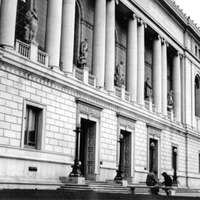
 The Statues representing Art, Literature, Philosophy, Science, and Law stood over seven feet tall. They were made of dark cement, a newer medium, and seemed better suited for their use outdoors than other sculptures because Lentelli did not include great detail on the figures. The figures are a mix of male and female reliefs with different objects held in the statues hands and by thier feet. One statue has a woman with a young boy at her feet, while another looks to have a bird sitting at the feet of a man. The figures are dressed in classical robes and each statue sat on granite bases. The statues sat above the San Francisco Main Library's main entrance until the building was repurposed in 1996 and they were removed.
-
 Leo Lentelli
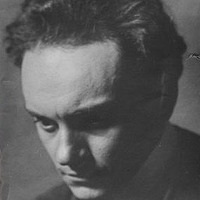
 Lentelli's date of birth is listed as November 29, 1879 by the Smithsonian, but most other sources claim it as October 29. Artistically trained in Bologna and Rome, Italy, Lentelli moved to America in 1903 and later became a citizen. He taught in New York and San Francisco while working as a sculptor nationally. His statues were distributed across the country, including locations in D.C., Virginia, and California. He is renowned for his "Golden Sprays," a set of nude figures showcased at the 1939 New York World's Fair. His family and he returned to Rome in 1955, where he passed away seven years later.
-
 Juno and Victory
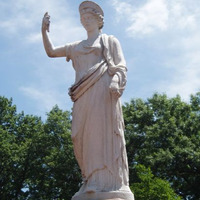
 Juno is modeled after the Farnese Juno, which is housed at the Naples National Museum. The Carrara marble statue portrays a woman dressed in a classical robe, with her arm held up and holding an object. The woman is wearing a crown or headdress. Victory is a copy of Vincenzo Consani's Victory at the Pitti Gallery in Florence. It depicts a seated woman in Carrara marble, covered in a cloak from the waist down. She gazes down and writes on the shield she holds. Her hair is put up and there is a sheathed sword at her side. The inscription on the base says "The Victory of Science Over Ignorance. Ignorance is the curse of God, knowledge is the wing wherewith we fly to heaven." The inscription gives the name many know the statue by "The Victory of Science."
-
 Carlo Nicoli
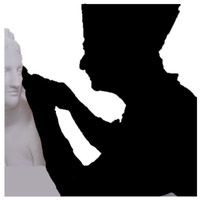
 Carlo Nicoli attended the Accademia di Belle Arti di Carrara, where he received numerous awards prior to his departure in 1864. Subsequently, he relocated to Florence to commence work under the mentorship of Giovanni Duprè. Nicoli is regarded as one of the more accomplished artists active in Florence during the mid-to-late nineteenth century. Nicoli opened a workshop in San Francesco, near Carrara, in 1876. He has limited work displayed in the U.S. His descendants still run his workshop today. He died in Carrara, Italy, in 1915.
-
 Car of History Clock
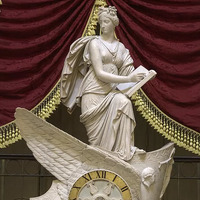
 Located above the north door of the National Statuary Hall at the US Capitol, Car of History is a statue depicting Clio, the Greek Muse of History, standing in her winged chariot. Clio's head is turned back to observe the past as her hands appear to suggest her writing that past down in a book. The chariot is adorned with a winged Nike blowing a trumpet on the front. Next to the Goddess of Victory is a profile bust of George Washington. Under the chariot is a partial globe with images of Sagittarius, Aries, and Aquarius. The wheel of the chariot is a clock; the current version was installed in 1835. The statue was carved from several pieces of Carrara marble and stands over seven feet tall.
-
 Carlo Franzoni
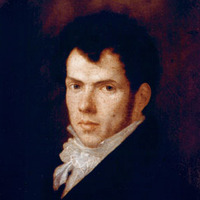
 Carlo Franzoni received his education at the Accademia di Belle Arti di Carrara, where he and his brother, Giuseppe Frazoni, were employed for a brief period. His brother moved to the United States in 1806 to work on the U.S. Capitol. Giuseppe passed away unexpectedly in 1815, a year after parts of his work at the Capitol, were destroyed in 1814 during the British Burning of Washington. His death prompted Carlo to relocate to Washington in 1816, with his cousin Francisco Iardella, to continue his brother's commissions and to pursue his own artistic pursuits. Regrettably, Carlo also passed away in D.C. unexpectedly in 1819 due to heart complications.
-
 The Capitals in the National Statuary Hall
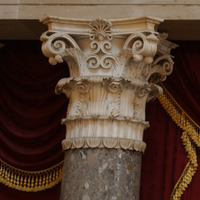
 The Capitals, the uppermost elements of columns that provide structural support, were designed in the Corinthian style. Carved from Carrara marble, they were modelled after the Choragic Monument of Lysicrates in Athens, Greece.
-
 Giovanni Andrei
 Another artist who studied at the Accademia di Belle Arti di Carrara, Giovanni Andrei, was renowned as an ornamental sculptor in Florence and Rome. In 1806, both Andrei and his Brother-in-Law, Giuseppe Franzoni, received invitations to the United States from Philip Mazzei, at the behest of Benjamin H. Latrobe, to contribute to the construction of the United States Capitol. During a period of concern regarding the funding for his work, Andrei also undertook projects around Washington and Baltimore. He returned to Italy in 1815 to work on recreating capitals for the US House of Representatives' chamber of the Capitol that were destroyed during the War of 1812. He returned to the US where he died in 1824.
-
 Giuseppe Franzoni
 Giuseppe Franzoni trained in sculpture with his brother, Carlo Franzoni, at the Accademia di Belle Arti di Carrara. In his youth he worked around Florence, with upkeep efforts of major sites. In 1806, he emigrated to the United States, accompanied by his brother-in-law, Giovanni Andrei, at the invitation of Philip Mazzi to assist Benjamin H. Latrobe in the construction of the U.S. Capitol. Regrettably, a portion of his work was lost in the destruction of the Capitol in 1814 during the British Burning of Washington, and he was unable to complete its recreation due to his unexpected death a year later.
-
 Liberty Statue
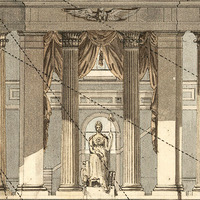
 What was, for a short time, the United States' first Statue of Liberty, was meant to be sculpted from Vermont marble. The plaster model, crafted by Franzoni, served as the central exhibit in the Hall of Representatives. Numerous design selections diverged from the original concept to the version modeled in 1814. Positioned between two columns and behind the speaker's chair, Liberty is depicted seated in a chair, exceeding eight feet in height, and attired in a Greek-style gown. A bald eagle, a detail mandated by Benjamin Henry Latrobe to Franzoni, is situated on Liberty's left side atop a rock. The U.S. Constitution is displayed in her right hand, while her left holds the Cap of Liberty. Her foot rests upon an inverted crown, symbolizing the rejection of monarchy. The British Burning of Washington destroyed the model that same summer in 1814.
-
 Benjamin Franklin Statue
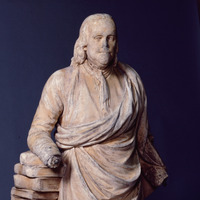
 Carved from Carrara marble, the sculpture of Benjamin Franklin depicts him wearing a traditional Roman toga, holding books under his left arm, which once supported a now-missing scepter held downward. His right hand grasped an open book or scroll. Both elements symbolize Franklin's opposition to monarchy. A replica now occupies its position, with the original removed for preservation.
-
 Francesco Lazzarini
 Francesco Lazzarini was born in Carrara, Italy and studied in Rome. Little is known of Lazzarini's life, but his art is well-regarded and was held in many incredible collections, including those of Peter I of Russia.
-
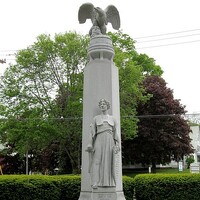 Rockingham War Memorial
 Carved from granite. A 4-foot sculpture of a female figure has a laurel leaf circlet on their head and is holding a sword in their right hand and a shield in their left. The shield is inscribed with "Deducated to Those Who Made the Supreme Sacrifice and to all Others from the Town of Rockingham who Entered the Service of Our Country in all Wars A.D. 1927. There is also a 13-foot pillar with an eagle standing on a ball.
-
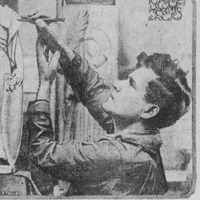 James S. Novelli
 Raised in New York, Novelli returned to Italy in 1903 to study art in Rome. He returned to the U.S. where finished much of his personal work in the 1920s before the depression. Novelli mostly worked in bronze. Novelli took his own life in 1940.
-
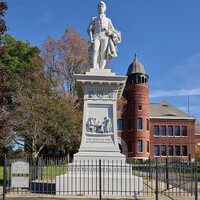 Robert Burns Monument
 A large relief with a statue carved from Barre Granite stands 22 feet tall. The statue is of Scottish poet Robert Burns. The figure is dressed in simple clothes with their coat draped over their arm. The four sides of the base include carvings of scenes from Burn's poems. the front has a scene from "The Cotter's Saturday Night" witht the words "From scenes like these old Scotia's grandeur springs." Under that, near the bottom, it says "Erected by Admirers of Burns." On the right side, facing the monument, it has a scene from "Tam o'Shanter's Ride" with the words "Ae spring brought off her master hale/ but left behind her ain grey tail." The other side has a scene from "To a Mountain Daisy," with the words "Wee, modest, crimson-tipped flow'r;/ Thou's met me in a evil hour." The back of the monument's base has an image of Burn's cottage with the words "Burn's Cottage."
-
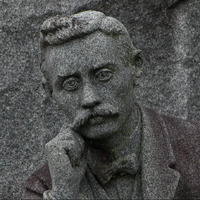 Elia Corti
 A dedicated socialist, Corti advocated for workers' rights and economic equality, aligning himself with the radical labor unions of the early 20th century. He moved to Barre, Vermont, a major location for sculptors in early American history. He was killed in 1903 during a small, politically driven fight.
-
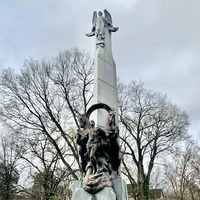 The Battle of Nashville Monument
 A thirty-foot high Granite obelisk topped with an Angel of Peace, with a bronze sculpture near its base of two rearing horses yoked together by a man symbolizing all Americans who fought in the Civil War and World War I. The word “UNITY” is inscribed on the banner with which he connects the horses. Inscribed on the granite base on the South side is "The Spirit Of Youth Holds In Check Contending Forces That Struggled Here At The Fierce Battle Of Nashville, Dec. 16th, 1864, Sealing Forever The Bond Of Union By The Blood Of Our Heroic Dead Of The World War 1917 – 1918. A Monument Like This, Standing On Such Memories, Having No Reference To Utilities, Becomes A Sentiment, A Poet, A Prophet, An Orator To Every Passerby." An inscription on the North side is inscribed "“Oh, Valorous Gray, In The Grave Of Your Fate, Oh, Glorious Blue, In The Long Dead Years, You Were Sown In Sorrow And Harrowed In Hate, But Your Harvest Today Is A Nations Tears. For The Message You Left Through The Land Has Sped From The Lips Of God To The Heart Of Man: Let The Past Be Past : Let The Dead Be Dead. — Now And Forever American!”" The Western face of the monument is inscribed "Battle of Nashville, 1864."
-
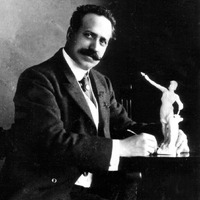 Giuseppe Moretti
 After showing skill at carving at a young age, Giuseppe Moretti studied in Florence. Arriving in the US in 1888, he worked all over the East Coast while keeping a studio in Florence, Italy. He eventually moved to Alabama after discovering the outstanding quality of its marble. His purchase of a quarry in Alabama was in part to challenge the import of Italian marble.
-
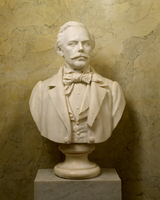 Bust of Thomas Crawford
 Bust of a man, Thomas Crawford, with a large mustache and a bowtie. Crawford was a U.S. senator and sculptor of many pieces for the Capitol building like Justice and History.
-
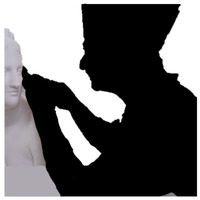 Tommaso Gagliardi
 Tommaso Gagliardi was apprenticed to the sculptor Pietro Tenerani, a pupil of Antonio Canova, and was briefly employed by Thomas Crawford in Italy. Gagliardi immigrated to the United States for political reasons, arriving in 1855. He found employment for three years carving statuary designed by Crawford for the Senate wing. He was a friend of the Piccirilli brothers. Prior to 1862, Gagliardi experienced an ailment in his shoulder that threatened to end his career; however, he reported that medical treatment in Vermont restored his ability to use his arm.
-
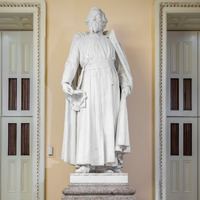 Monument to Jacques Marquette
 Jacques Marquette, a bearded man, holding his robe with a rosary and crucifix in his belt, is made of white marble standing on a plinth that says "Wisconsin's Tribute" "James Marquette S.J., Who, With Louis Joliet Discovered the Mississippi River at Prairie du Chein, Wis. June 17, 1673."
-
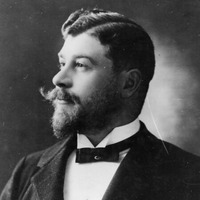 Gaetano Trentanove
 Gaetano Trentanove was born and trained in sculpting in his home city of Florence, Italy. After a successful early career in Italy and selling the marble statue The Last of the Spartans to William E. Cramer, Trenanove moved to Milwaukee, Wisconsin. He worked on projects across America, including in the U.S. Capitol. He became an American citizen and worked with both stone and bronze. He continued to visit Florence to work on his projects yearly. After retiring from the arts, he moved back to his beloved birth home where he would pass on.
-
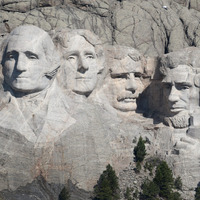 Mount Rushmore
 The heads of four presidents, George Washington, Thomas Jefferson, Theodore Roosevelt, and Abraham Lincoln, are carved into Mount Rushmore, known by the Lakota as Six Grandfathers.
-
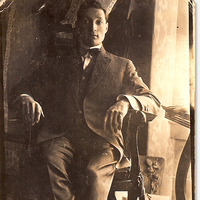 Luigi Del Bianco
 Luigi del Bianco began working for Gutzon Borglum, the head carver of Mount Rushmore, in 1933. Bianco was to carve detail in the faces of the Presidents at Mount Rushmore National Memorial. He worked specifically with Lincoln's eyes and a crack in Jefferson's lip. Recognized for his crucial role in 2017. Also worked on Borglum's Stone Mountain and Wars of America.