promo booklet page 2.jpg
Media
Part of Promotional Booklet Page 2
- source resource
- https://ashleynicolepage.com/OmekaS/api/media/49
- extracted text
-
“If the state of Louisiana can’t build a domed
stadium then we should content ourselves with
sitting on the banks of the Mississippi telling
one another what great people we were in
granddaddy's day.”
‘These words spoken by Governor John J.
McKeithen at a meeting of the Chamber of
Commerce warmed up a cold February
afternoon in 1966, lighting a fuse that started
a blastoff of a domed stadium in the
metropolitan area of New Orleans.
Louisiana’s chief executive, addressing leaders
of business, finance, labor, education,
religion and civic groups, stated emphatically:
“We're going to build the finest domed stadium
anywhere, whether we get a National Football
League franchise or not.””
Nine months later, on November 1, 1966,
appropriately All Saints Day, there came the
enthusiastically received announcement
from NFL Commissioner Pete Rozelle that the
New Orleans Saints had been born,
‘The following week, on November 8,
Louisianians went to the polls and voted
overwhelmingly “yes” for Constitutional
Amendment Number 10 which created the
Louisiana Stadium and Exposition District
with authority to build a multi-purpose domed
stadium in Orleans or Jefferson Parishes
‘The voters demonstrated unmistakably that
they wanted this great new industry, this
symbol of a new pride in a new Louisiana.
ince that vote, despite frustrating delays and
problems that would have tried the patience of
Job, steady and certain progress has been made
on the spectacular multi-use complex now
popularly known as the Louisiana Superdome.
During January of 1967, eleven outstanding
civic leaders and public officials were named
to the newly created authority’s eleven man
board of commissioners. Dave Dixon, a native
Louisianian and the prime mover in landing
the coveted NFL franchise for New Orleans,
was appointed executive director.
A talented architectural-engineering team
comprising the firms of Curtis and Davis,
Architects of New Orleans and New York;
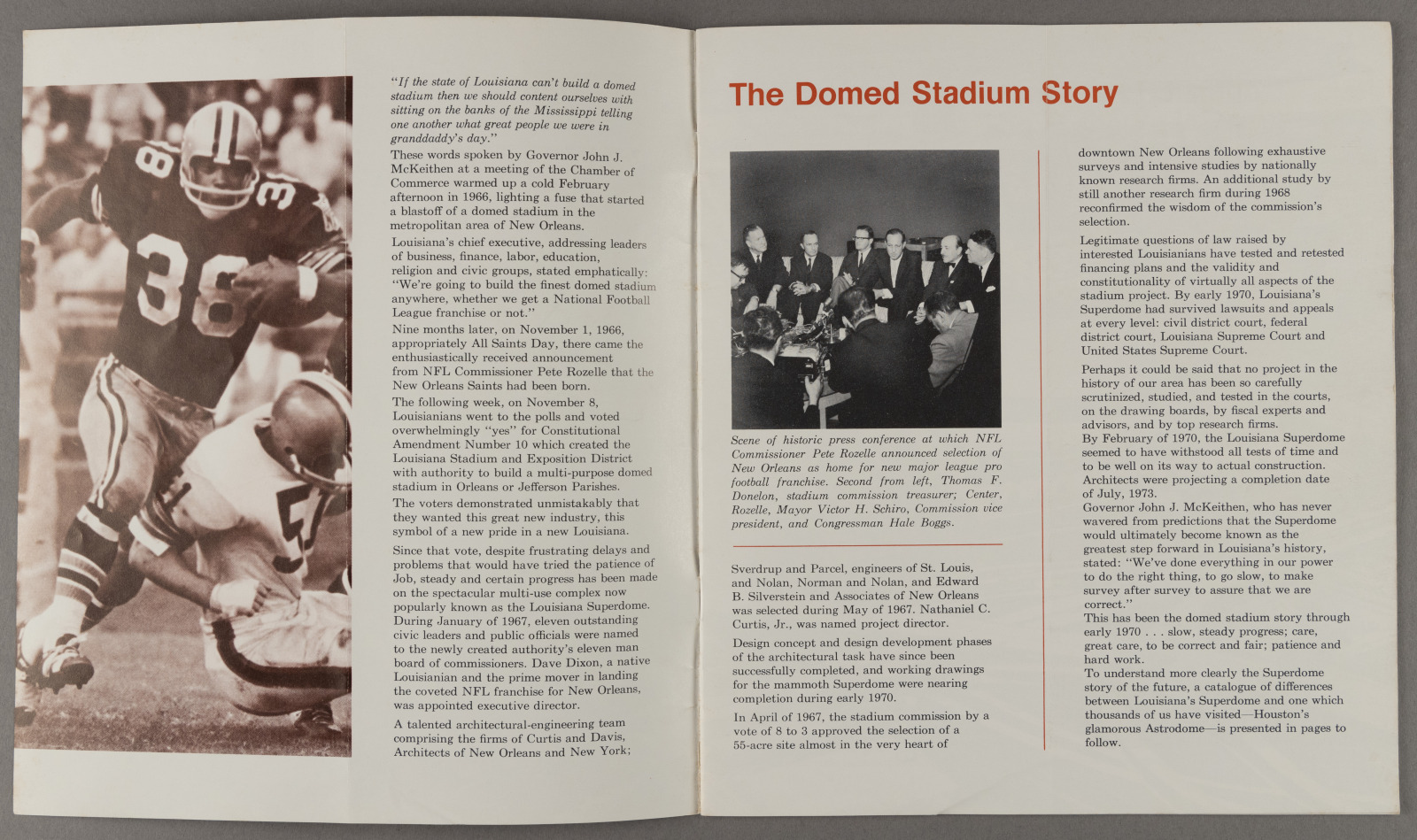
Scene of historic press conference at which NFL
Commissioner Pete Rozelle announced selection of
New Orleans as home for new major league pro
football franchise. Second from left, Thomas F.
Donelon, stadium commission treasurer; Center,
Rozelle, Mayor Victor H. Schiro, Commission vice
president, and Congressman Hale Boggs.
Sverdrup and Parcel, engineers of St. Louis,
and Nolan, Norman and Nolan, and Edward
B, Silverstein and Associates of New Orleans
was selected during May of 1967. Nathaniel C.
Curtis, Jr., was named project director.
Design concept and design development phases
of the architectural task have since been
sucessfully completed, and working drawings
for the mammoth Superdome were nearing
completion during early 1970.
In April of 1967, the stadium commission by a
vote of 8 to 3 approved the selection of a
55-acre site almost in the very heart of
downtown New Orleans following exhaustive
surveys and intensive studies by nationally
known research firms. An additional study by
still another research firm during 1968
reconfirmed the wisdom of the commission's
selection.
Legitimate questions of law raised by
interested Louisianians have tested and retested
financing plans and the validity and
constitutionality of virtually all aspects of the
stadium project. By early 1970, Louisiana's
‘Superdome had survived lawsuits and appeals
at every level: civil district court, federal
district court, Louisiana Supreme Court and
United States Supreme Court.
Perhaps it could be said that no project in the
history of our area has been so carefully
scrutinized, studied, and tested in the courts,
on the drawing boards, by fiscal experts and
advisors, and by top research firms.
By February of 1970, the Louisiana Superdome
seemed to have withstood all tests of time and
to be well on its way to actual construction.
Architects were projecting a completion date
of July, 1973.
Governor John J. MeKeithen, who has never
wavered from predictions that the Superdome
would ultimately become known as the
greatest step forward in Louisiana’s history
stated: “We've done everything in our power
to do the right thing, to go slow, to make
survey after survey to assure that we are
‘This has been the domed stadium story through
early 1970 . . . slow, steady progress; care,
great care, to be correct and fair; patience and
hard work.
To understand more clearly the Superdome
story of the future, a catalogue of differences
between Louisiana's Superdome and one which
thousands of us have visited—Houston’s
glamorous Astrodome—is presented in pages to
follow.