Monuments and Statues by Italian Artists

Monuments and statues constructed from stone are intended to serve as enduring symbols of architects’ visions. During the development of the American architectural landscape, stone monuments were erected as emblems of memory and heritage, as well as a means of relating to the voting public. Materials such as marble and granite, renowned for their durability and tradition, were deemed ideal for the image that the leaders of American public spaces sought to project. These monuments should be viewed not only as individual markers of wars, notable figures, and philosophies but also as components of a broader movement. Many of the monuments detailed below were established during the era recognized as Statue Mania, spanning from 1870 to 1920, a period marked by a proliferation of monument construction throughout Western countries. Commemorative structures in stone serve to reinforce collective narratives of struggles for liberty and identity, embedding these stories within the physical landscape of the United States. It is important to acknowledge, however, that some monuments erected by Italians were conceived with the intent of conveying the messages associated with the Confederate philosophy of the Lost Cause in the U.S. In the Southern United States, organizations such as the United Daughters of the Confederacy utilized these monuments as symbols of their version of history, which romanticized the antebellum South and regarded the Confederate soldier as a hero of personal liberty. These narratives neglect the abhorrent history of slavery in the U.S. Contemporary perspectives have increasingly regarded markers such as Confederate monuments and statues of Christopher Columbus as problematic, and their ongoing presence has ignited discussions regarding the removal of these statues from public spaces.

The New York Stock Exchange Pediment
The Georgian marble pediment at the entrance of the New York Stock Exchange is also known as "Integrity Protecting the Works of Man" and features eleven figures. The central figure is a robed woman representing Integrity, wearing a winged cap and extending both arms outward. At her feet sit two nude children. To her right is a nude man holding gears symbolizing mechanical production, alongside another man with his hand on a ship's wheel, signifying international trade. Adjacent to these men are two individuals studying charts, symbolizing the realization of intelligence and scientific advancement. On the left side of Integrity is another nude male carrying a heavy bag, and next to him is a dressed female holding a distaff; these figures represent agriculture. Further to the left are the figures associated with mining: two nude males examining a rock. The eleven figures are flanked by waves. The pediment was replaced in 1936 with a replica composed of lighter copper and lead, owing to weather-related deterioration.
The Four Continents
The Four Continents
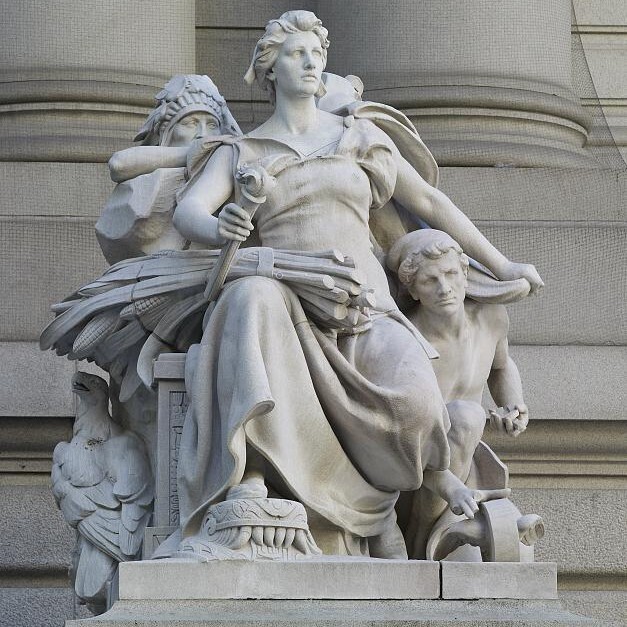
Four statues are situated outside the entrance of the Alexander Hamilton U.S. Custom House in New York City. These sculptures, representing Africa, America, Asia, and Europe, are crafted from Tennessee marble and depict women holding instruments that symbolize their respective continents. The European figure portrays a mature woman seated on a throne, adorned with a crown. She wears a Greek-style gown and a breastplate, with the throne featuring imagery of the Parthenon, and her hand resting on a ship’s prow. Behind her, the throne’s back right displays three prows forming the heads of a lion, an eagle, and a bear. The woman's left arm rests on an open book placed on a globe. Behind her stands another hooded figure, an elderly woman symbolizing History, holding a skull and a scroll. The Asian figure is depicted as a tranquil woman, with eyes closed, dressed in robes suggesting Buddhist faith. A small Buddha statue sits in her lap, and she holds a lotus flower entwined with snakes. She sits on a throne supported by skulls, with a tiger to her right and three figures to her left: a young boy in prayer, a man with hands tied behind his back and bowing forward, and a woman carrying a baby behind the main figure. Additionally, behind the Asian figure, there is a cross symbolizing the birth of Christianity on the continent. The African figure is a nude woman seated on a stone throne, with a lion beneath her left arm, set against Egyptian motifs. To her right is the Great Sphinx of Giza, with a hooded figure behind her. The American figure is a young woman holding a torch of liberty in her hand. Progress is symbolized by a kneeling man under America's robe. Corn stocks sit on her lap as she rises from an Aztec carved throne. An eagle and cacti are positioned on her right, and a Native American man stands behind her, observing her embodiment of progress.
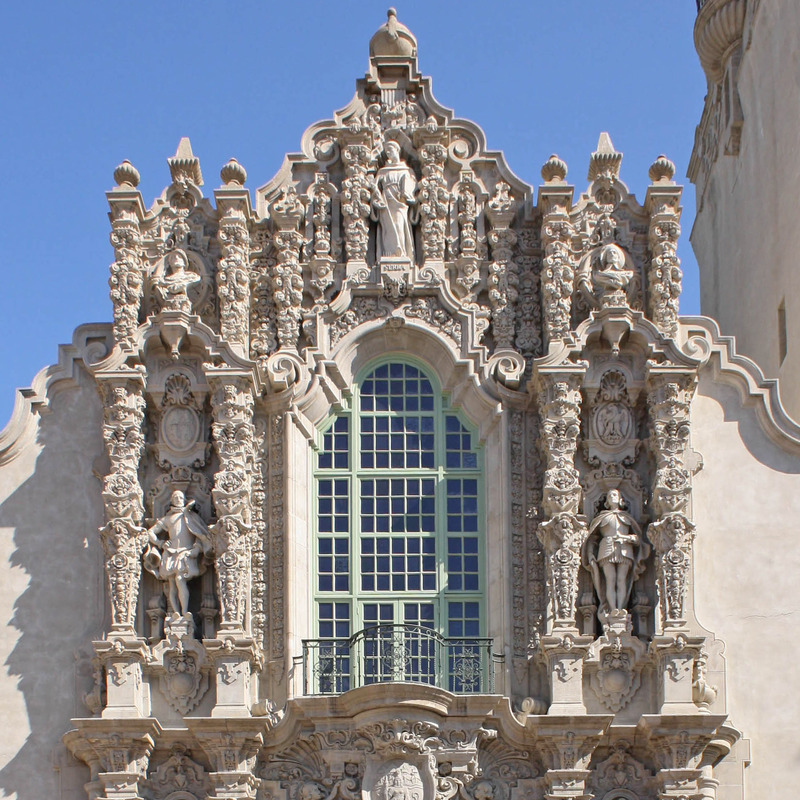
California State Building Frontispiece
The frontispiece on the southern façade of the California Building in San Diego, California, was created for the 1915 Panama-California Exposition. The façade is a complex concrete wall featuring an array of architectural figures, statues, and coats of arms, all embedded in molds fashioned by the Piccirilli brothers. These brothers were primarily responsible for the sculptures and busts depicting figures such as Father Junipero Serra, Philip III of Spain, Sebastian Vizcaino, George Vancouver, Father Luis Jayme, Charles V of Spain, Juan Rodriguez Cabrillo, Gaspar de Portola, Father Antonio de la Ascension, as well as the coats of arms of Mexico and California. The style mixes designs found in Spanish and Mexican churches and creating an iconic visage for San Diego.
Lincoln Memorial
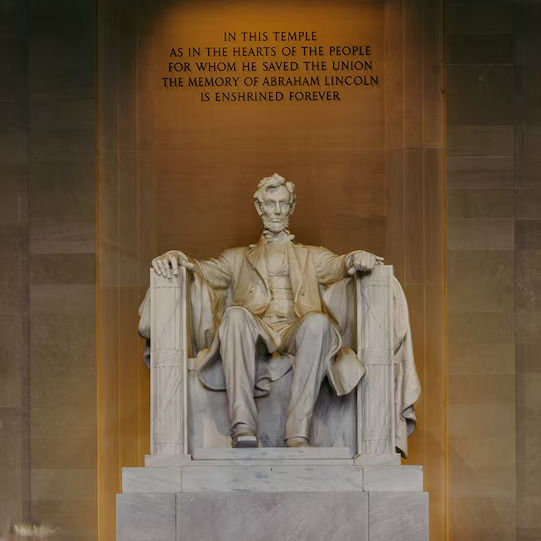
Lincoln Memorial
The colossal figure, carved from Georgia marble, took over four years to complete. It depicts Lincoln seated in a large chair, and even in that pose, the figure is around 19 feet tall. The pedestal is of Tennessee marble, on which Lincoln's arms rest atop Roman fasces. Behind the seated Lincoln the wall is inscribed with "In This Temple as in the Hearts of the People for Whom He Saved the Union the Memory of Abraham Lincoln is Enshrined Forever."
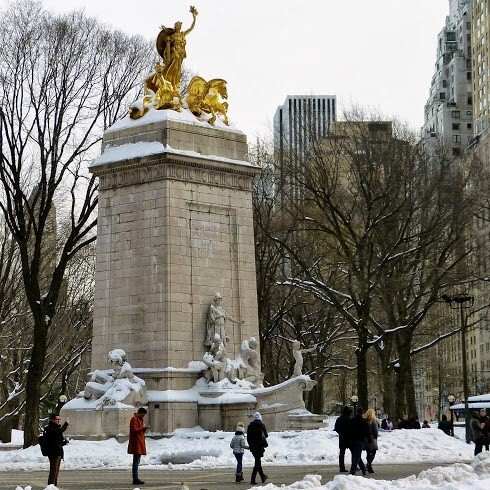
USS Main National Monument
Atop a 40-foot pillar of Tennessee marble and a granite base stands a metal sculpture of Columbia, the female personification of the U.S., with a seashell chariot being led by three hippocampi. That sculpture is menat to be made of cannons from the USS Maine. Surrounding the base of the monument is a fountain. Surrounding the pillar are statues dedicated to the Pacific and Atlantic oceans. The Atlantic is personified as a young man sitting while the Pacific is an older man laying down. In front of the pillar is a group of sculpted people called "The Antebellum State of Mind: Courage Awaiting the Flight of Peace, and Fortitude Supporting the Feeble." The sculptures stand on a marble boat helm and include one of a young boy holding a wreath in the foreground, Lady Justice in the background, arms outstretched. At her feet is a mother holding her child and a muscular man. The back of the pillar has a sculpture group titled "The Post Bellum Idea: Justice Receiving Back the Sword Entrusted to War." Here, Lady Justice stands again with arms outstretched to two male figures at her feet. Inscribed in the front are the words "To the Valiant Seamen who Perished in the Maine by Fate Unwarned in Death Unafraid - MDCCCXCVIII (1898) MCMXII (1912). The back has two inscriptions. One says "To the Freeman who Died in the War with Spain that Others Might be Free - MDCCCXCVIII (1898) MCMXII (1912)." The other says, "Erected through public subscription by the National Maine Monument Committee: James Grant Wilson, Chairman; William R. Hearst; George F. Shrady; John W. Keller; and J. Edward Simmons."
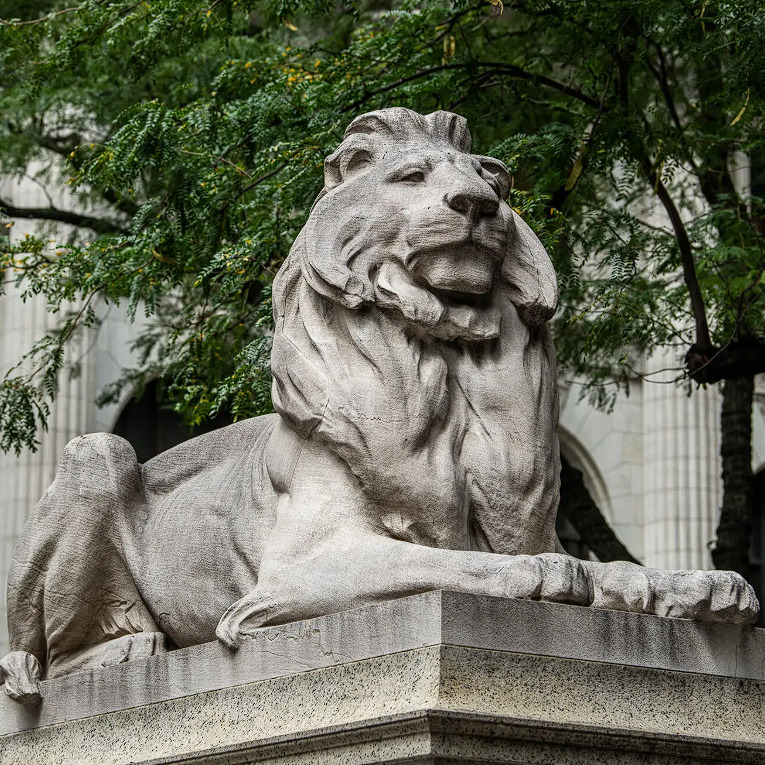
New York Public Library Lions
These male lions, known today as Patience and Fortitude, were made of Tennessee marble. They sit at either side of the library's steps and are images often referenced for the library in its logo and other materials. The lions lay on stone plinths guarding the library.
Washington Monument
Washington Monument
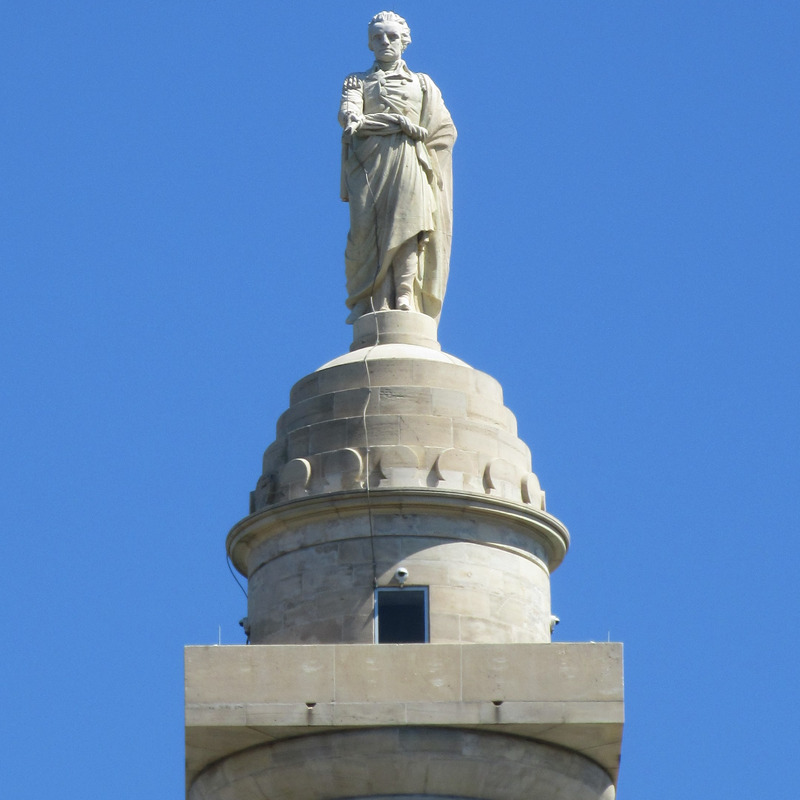
Sitting atop Robert Mill's Doric column, the figure of George Washington stands over 14 feet tall. Made of marble, Washington wears a classical Roman toga while handing his commission as Commander-in-Chief.
Bust of George Washington
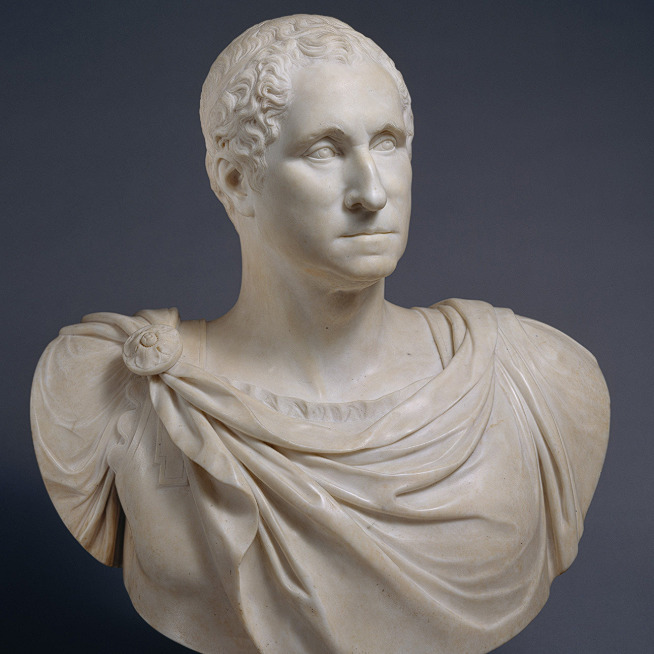
Washington's bust is crafted from Carrara marble and portrays George Washington adorned in a classical Roman toga, with short wavy hair. The sculpture bears resemblance to images of Caesar, yet the facial features are a widely recognized representation of Washington. Initially, the bust created by Ceracchi was crafted from terracotta in 1791, but he completed the marble version in 1794, with modifications made during a sitting with Washington in 1795.
Tripoli Monument
Tripoli Monument
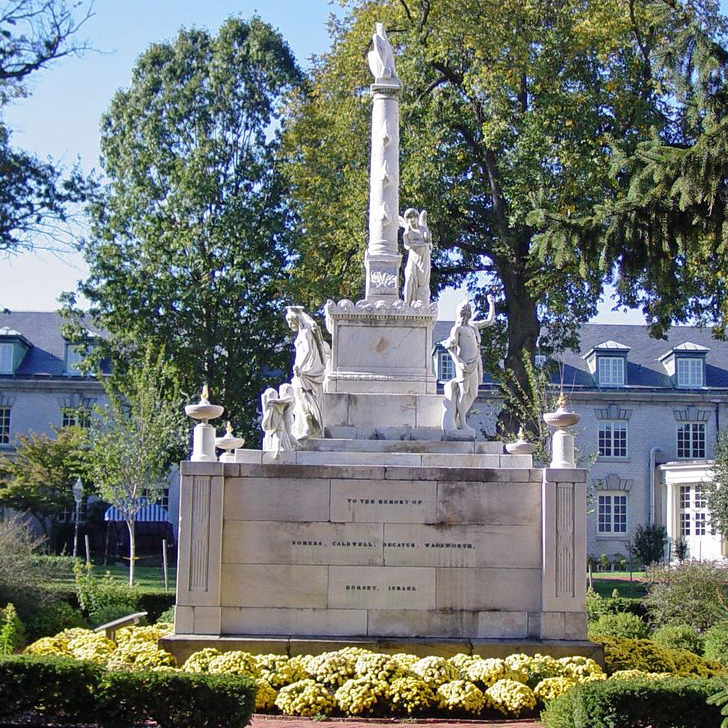
The Tripoli monument features a thirty-foot-high Carrara marble rostral column, characterized by a column with ships sailing through it, topped by an eagle. The sandstone base supports four figures: America, History, Commerce, and Victory. A Native American woman symbolizes America with two children by her side; History is depicted by a woman seated and writing in a book. Victory is represented as a classical winged figure positioned atop the base, holding a laurel wreath and a bronze palm branch. Commerce is portrayed by a male figure who points to the column with his right hand and holds a caduceus in his left. All four sides of the base are engraved. The small base on the north side has the artists signature, "Giov. Charles Micali Invento / In Livorno 1806." The west says "The Love of Glory Inspired Them / Fame Has Crowned Their Deeds / History Records the Event / The Children of Columbia Admire / And Commerce Laments Their Fall." The east is inscribed "As a Small Tribute of Respect to Their Memory / And of Admiration of Their Valour / So Worthy of Imitation / Their Brother Officers / Have Erected This Monument." The south side says "Erected in the Memory of Captain / Richard Somers, Lieutenant / James Caldwell, James Decatur, / Henry Wadsworth, Joseph Israel, / And John Dorsey Who Fell in the Different / Attacks that Were Made on the City of Tripoli / In the Year of our Lord 1804 / And in the 28 Year of The Independence / Of the United States." The larger base has the same inscription on all four sides, "To The Memory of / Somers, Caldwell, Decatur, Wadsworth, / Dorsey, Israel."
Tobacco Column Capitals
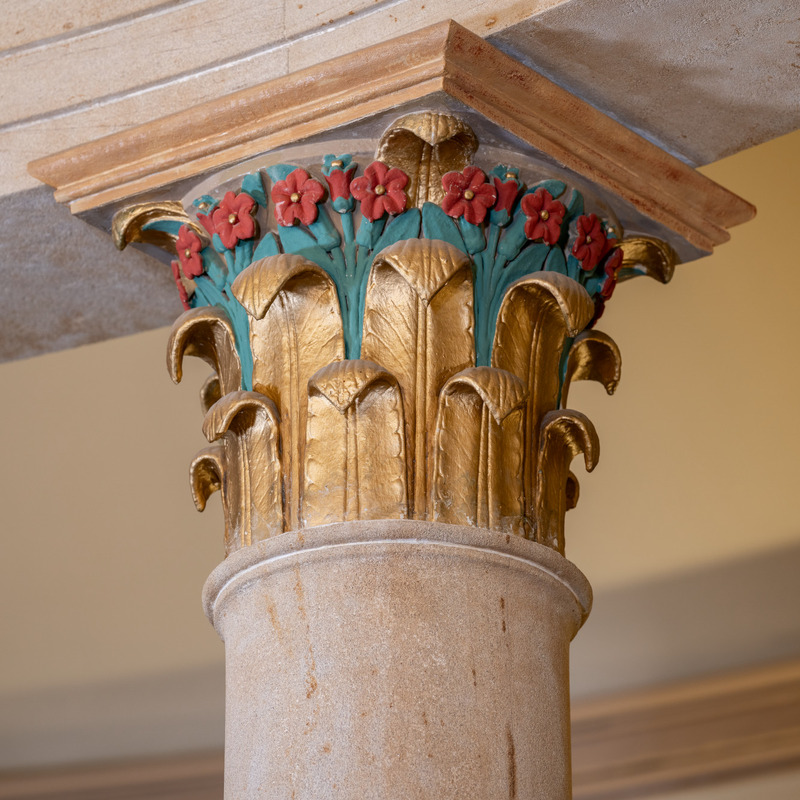
Within the Small Senate Rotunda, a spacious circular chamber crowned by a dome, there exists a configuration of sixteen columns adorned with capitals. These capitals are intricately modeled to imitate the leaves and flowers of the tobacco plant. Carved from sandstone, they are painted with leaves gilded in gold and flowers depicted in red with green stems.
Five Symbolic Figures
The Statues representing Art, Literature, Philosophy, Science, and Law stood over seven feet tall. They were made of dark cement, a newer medium, and seemed better suited for their use outdoors than other sculptures because Lentelli did not include great detail on the figures. The figures are a mix of male and female reliefs with different objects held in the statues hands and by thier feet. One statue has a woman with a young boy at her feet, while another looks to have a bird sitting at the feet of a man. The figures are dressed in classical robes and each statue sat on granite bases. The statues sat above the San Francisco Main Library's main entrance until the building was repurposed in 1996 and they were removed.
Juno and Victory
Juno and Victory
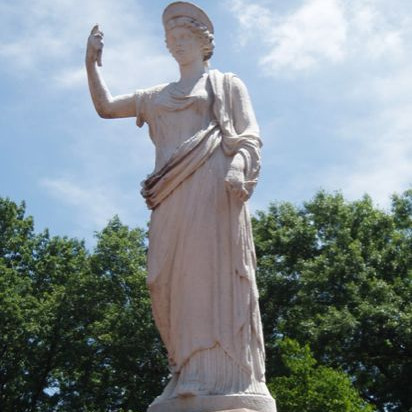
Juno is modeled after the Farnese Juno, which is housed at the Naples National Museum. The Carrara marble statue portrays a woman dressed in a classical robe, with her arm held up and holding an object. The woman is wearing a crown or headdress. Victory is a copy of Vincenzo Consani's Victory at the Pitti Gallery in Florence. It depicts a seated woman in Carrara marble, covered in a cloak from the waist down. She gazes down and writes on the shield she holds. Her hair is put up and there is a sheathed sword at her side. The inscription on the base says "The Victory of Science Over Ignorance. Ignorance is the curse of God, knowledge is the wing wherewith we fly to heaven." The inscription gives the name many know the statue by "The Victory of Science."
Car of History Clock
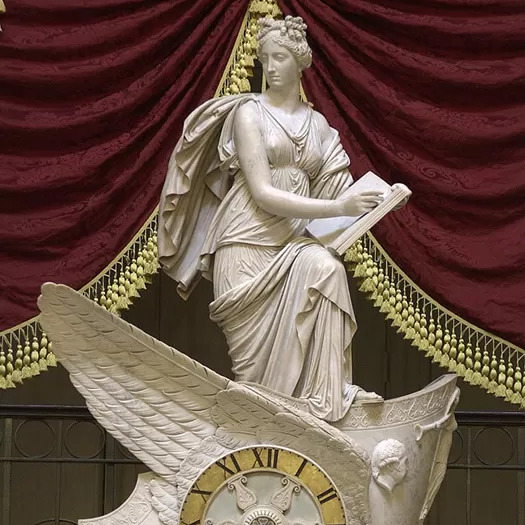
Located above the north door of the National Statuary Hall at the US Capitol, Car of History is a statue depicting Clio, the Greek Muse of History, standing in her winged chariot. Clio's head is turned back to observe the past as her hands appear to suggest her writing that past down in a book. The chariot is adorned with a winged Nike blowing a trumpet on the front. Next to the Goddess of Victory is a profile bust of George Washington. Under the chariot is a partial globe with images of Sagittarius, Aries, and Aquarius. The wheel of the chariot is a clock; the current version was installed in 1835. The statue was carved from several pieces of Carrara marble and stands over seven feet tall.
The Capitals in the National Statuary Hall
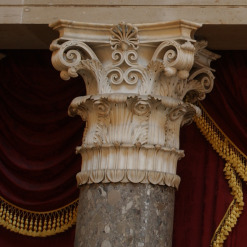
The Capitals, the uppermost elements of columns that provide structural support, were designed in the Corinthian style. Carved from Carrara marble, they were modelled after the Choragic Monument of Lysicrates in Athens, Greece.
Liberty Statue
Liberty Statue
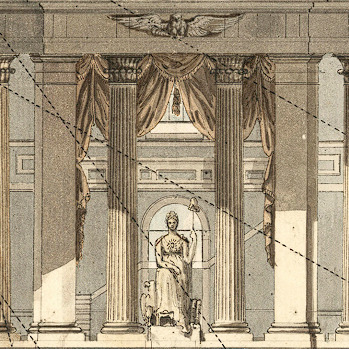
What was, for a short time, the United States' first Statue of Liberty, was meant to be sculpted from Vermont marble. The plaster model, crafted by Franzoni, served as the central exhibit in the Hall of Representatives. Numerous design selections diverged from the original concept to the version modeled in 1814. Positioned between two columns and behind the speaker's chair, Liberty is depicted seated in a chair, exceeding eight feet in height, and attired in a Greek-style gown. A bald eagle, a detail mandated by Benjamin Henry Latrobe to Franzoni, is situated on Liberty's left side atop a rock. The U.S. Constitution is displayed in her right hand, while her left holds the Cap of Liberty. Her foot rests upon an inverted crown, symbolizing the rejection of monarchy. The British Burning of Washington destroyed the model that same summer in 1814.
Benjamin Franklin Statue
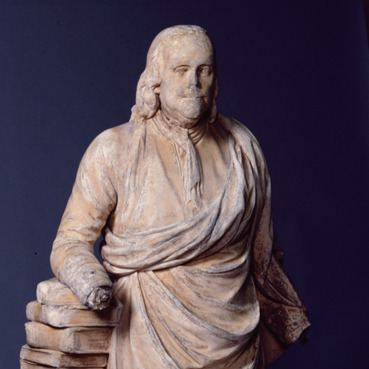
Carved from Carrara marble, the sculpture of Benjamin Franklin depicts him wearing a traditional Roman toga, holding books under his left arm, which once supported a now-missing scepter held downward. His right hand grasped an open book or scroll. Both elements symbolize Franklin's opposition to monarchy. A replica now occupies its position, with the original removed for preservation.
Rockingham War Memorial
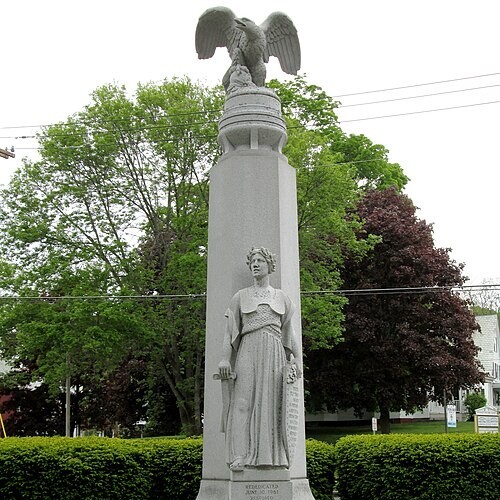
Carved from granite. A 4-foot sculpture of a female figure has a laurel leaf circlet on their head and is holding a sword in their right hand and a shield in their left. The shield is inscribed with "Deducated to Those Who Made the Supreme Sacrifice and to all Others from the Town of Rockingham who Entered the Service of Our Country in all Wars A.D. 1927. There is also a 13-foot pillar with an eagle standing on a ball.
Robert Burns Monument
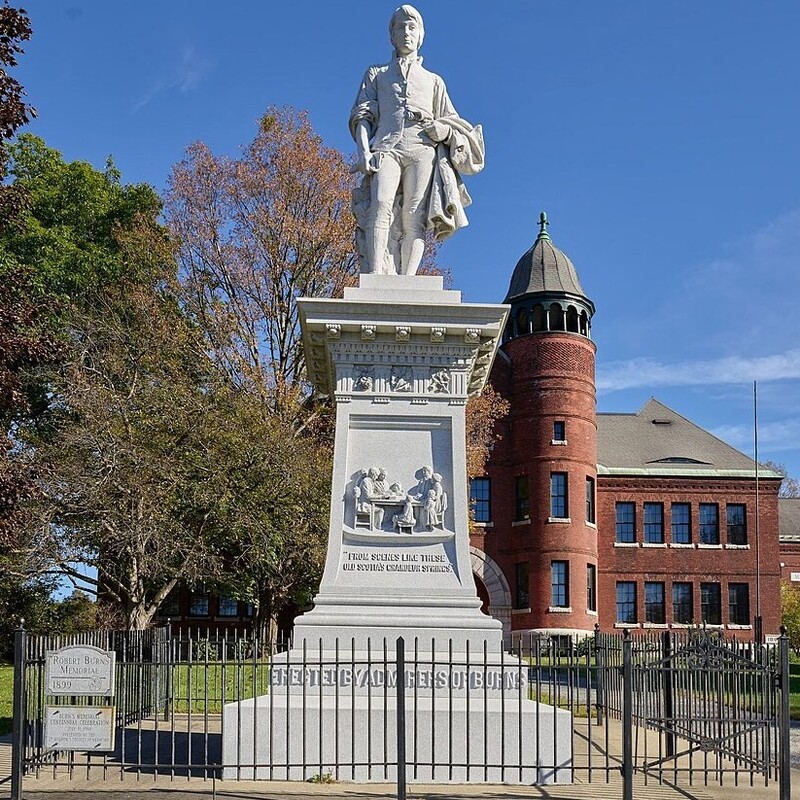
A large relief with a statue carved from Barre Granite stands 22 feet tall. The statue is of Scottish poet Robert Burns. The figure is dressed in simple clothes with their coat draped over their arm. The four sides of the base include carvings of scenes from Burn's poems. the front has a scene from "The Cotter's Saturday Night" witht the words "From scenes like these old Scotia's grandeur springs." Under that, near the bottom, it says "Erected by Admirers of Burns." On the right side, facing the monument, it has a scene from "Tam o'Shanter's Ride" with the words "Ae spring brought off her master hale/ but left behind her ain grey tail." The other side has a scene from "To a Mountain Daisy," with the words "Wee, modest, crimson-tipped flow'r;/ Thou's met me in a evil hour." The back of the monument's base has an image of Burn's cottage with the words "Burn's Cottage."
The Battle of Nashville Monument
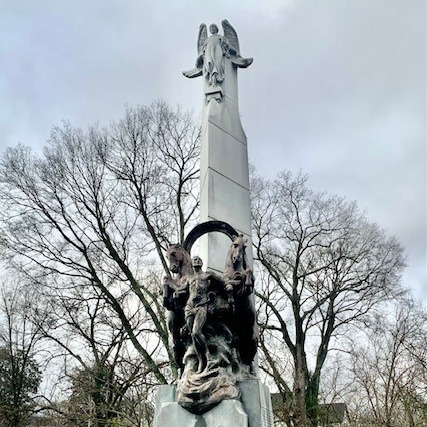
A thirty-foot high Granite obelisk topped with an Angel of Peace, with a bronze sculpture near its base of two rearing horses yoked together by a man symbolizing all Americans who fought in the Civil War and World War I. The word “UNITY” is inscribed on the banner with which he connects the horses. Inscribed on the granite base on the South side is "The Spirit Of Youth Holds In Check Contending Forces That Struggled Here At The Fierce Battle Of Nashville, Dec. 16th, 1864, Sealing Forever The Bond Of Union By The Blood Of Our Heroic Dead Of The World War 1917 – 1918. A Monument Like This, Standing On Such Memories, Having No Reference To Utilities, Becomes A Sentiment, A Poet, A Prophet, An Orator To Every Passerby." An inscription on the North side is inscribed "“Oh, Valorous Gray, In The Grave Of Your Fate, Oh, Glorious Blue, In The Long Dead Years, You Were Sown In Sorrow And Harrowed In Hate, But Your Harvest Today Is A Nations Tears. For The Message You Left Through The Land Has Sped From The Lips Of God To The Heart Of Man: Let The Past Be Past : Let The Dead Be Dead. — Now And Forever American!”" The Western face of the monument is inscribed "Battle of Nashville, 1864."
Bust of Thomas Crawford
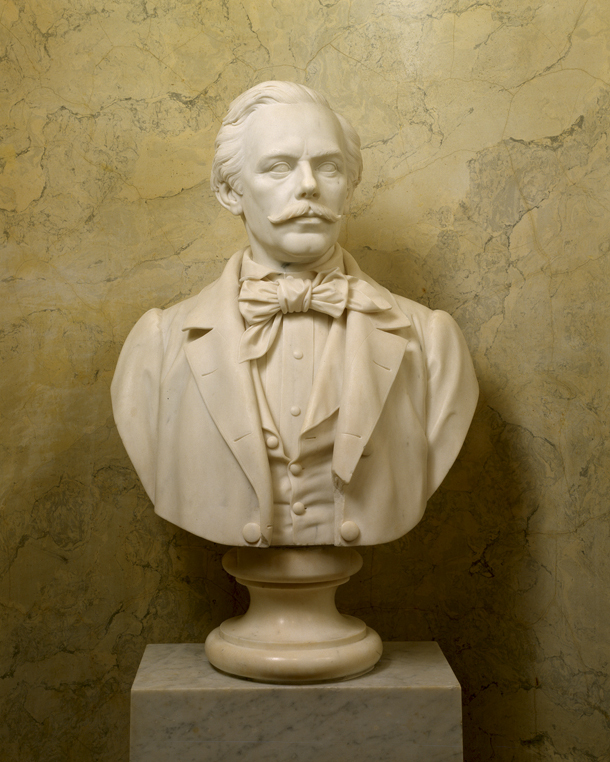
Bust of a man, Thomas Crawford, with a large mustache and a bowtie. Crawford was a U.S. senator and sculptor of many pieces for the Capitol building like Justice and History.
Monument to Jacques Marquette
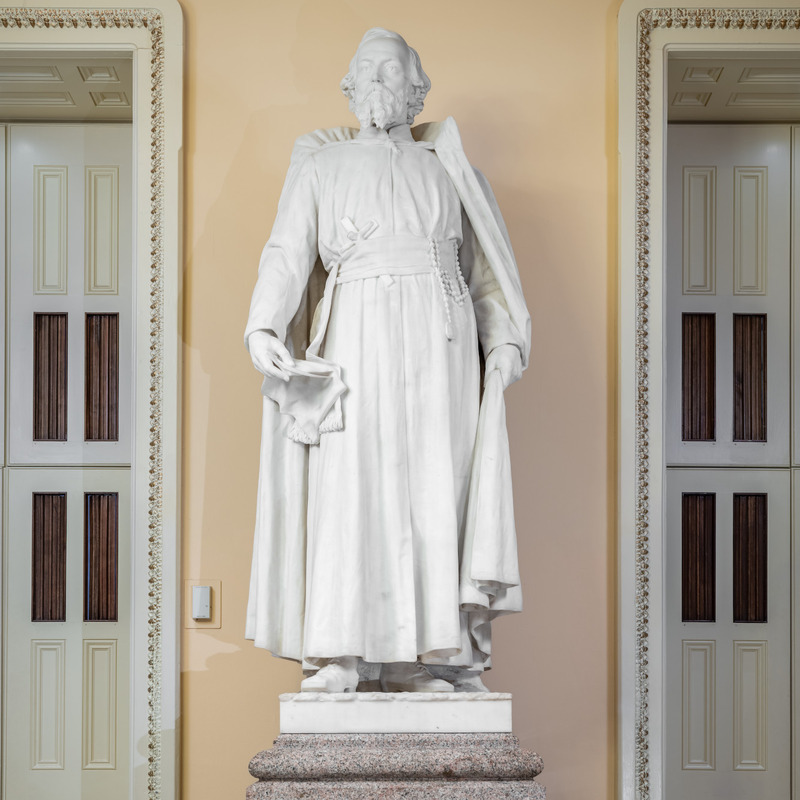
Jacques Marquette, a bearded man, holding his robe with a rosary and crucifix in his belt, is made of white marble standing on a plinth that says "Wisconsin's Tribute" "James Marquette S.J., Who, With Louis Joliet Discovered the Mississippi River at Prairie du Chein, Wis. June 17, 1673."
Mount Rushmore
Mount Rushmore
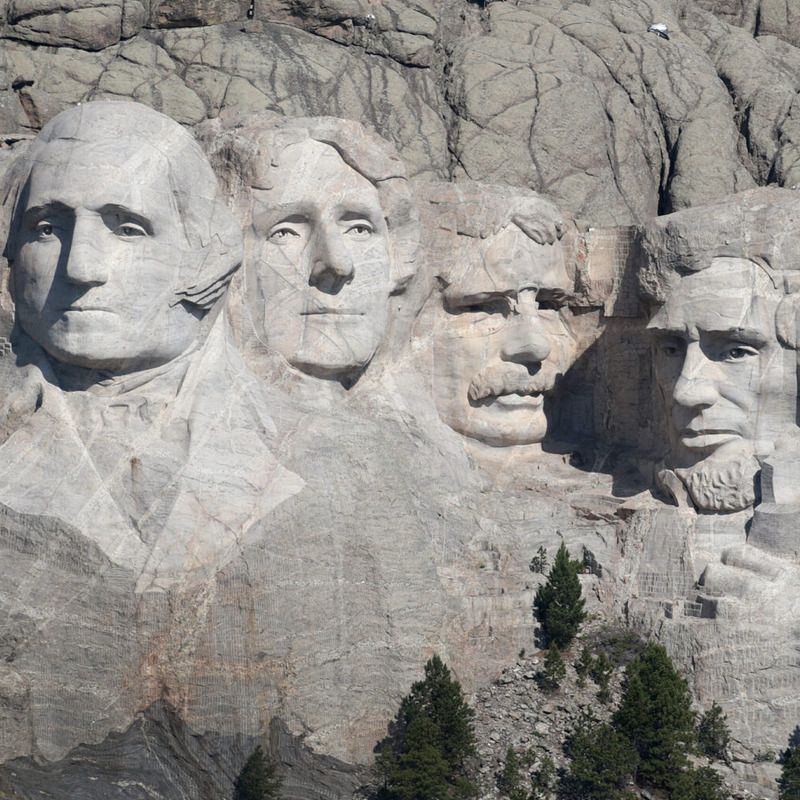
The heads of four presidents, George Washington, Thomas Jefferson, Theodore Roosevelt, and Abraham Lincoln, are carved into Mount Rushmore, known by the Lakota as Six Grandfathers.
Fame & Peace Crowning George Washington
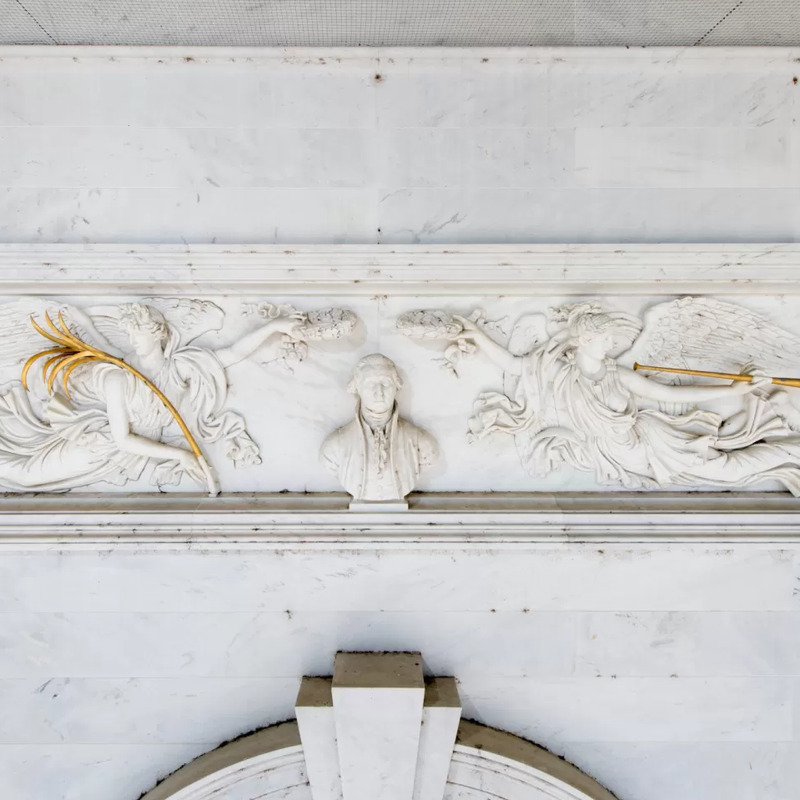
Two winged figures, hovering in the air, crown the bust of George Washington with laurel wreaths. Fame, on the right, holds a trumpet, and Peace, on the left, a palm branch. Replaced for preservation during the East Front extension of the US Capitol between 1958-1960, copy created by the Vermont Marble Company
Lady Baltimore, Battle Monument
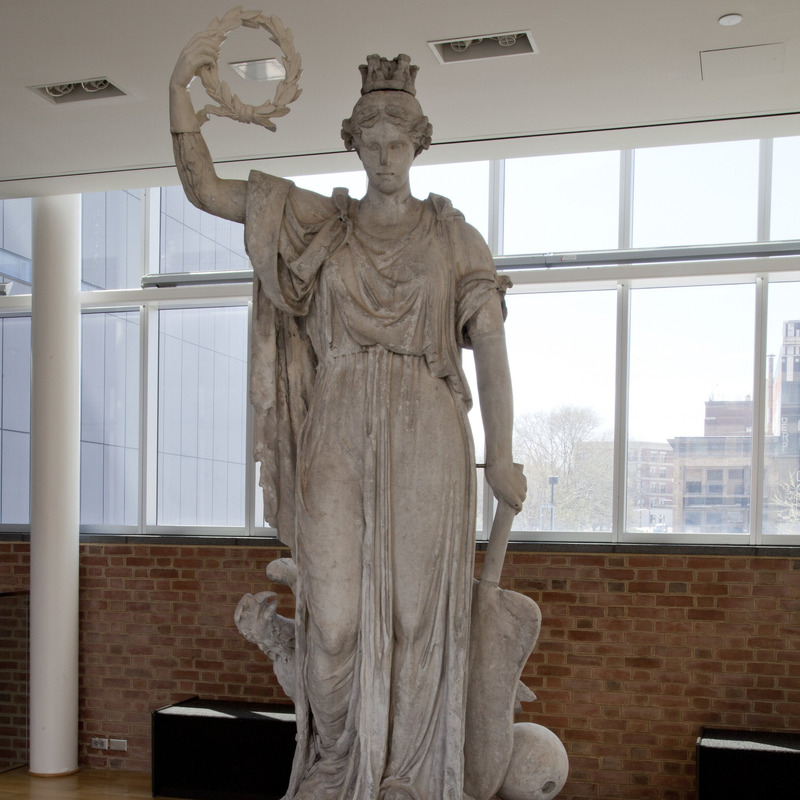
The monument's column, wrapped with the names of those who died in the battle, is the first of its kind ever erected in the United States. 'Lady Baltimore,' depicted as a Roman The monument's column, wrapped with the names of those who died in the battle, is the first of its kind ever erected in the United States. 'Lady Baltimore,' depicted as a Roman matron, symbolizes the city. made of Carrara marble She wears a crown which is thought to symbolize Baltimore and holds a laurel wreath, a symbol of victory, in her raised hand. At her feet are an American Eagle and a bomb to act in remembrance of the bombardment. Her lowered hand holds a rudder, symbolic of navigation and stability. She originally faced the harbor, a source of Baltimore's prosperity and fortune. After several repairs and replacements to the statue, the statue was moved to the Maryland Historical Society in 2013.
The Discovery of America
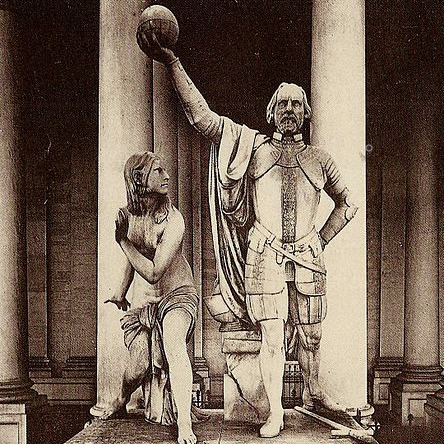
Sculpture group depicts Columbus attired in a suit of armor striding boldly forward holding a globe above him as a nude Native American woman shrinks back in terror. made of Seravezza marble, its deterioration was so severe by 1958 it was placed in storage. The American Indian Advocacy successfully advocated for the removal of the item from future renovation plans.
War and Peace
War and Peace
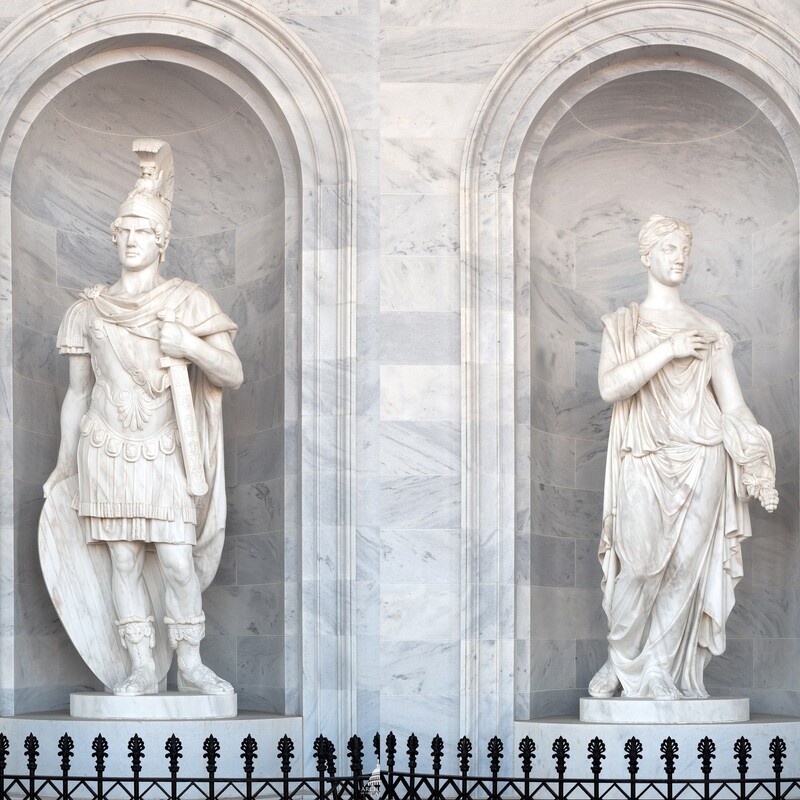
"War" is a male figure with his head slightly tilted and his gaze fixed ahead. His left hand holds the hilt of his sheathed sword and his right supports his shield as it rests upon the ground. He wears the costume of an ancient Roman, with a toga over his shoulders and a tunic extending as low as his knees; its border, like his belt, is richly ornamented. "Peace" is a female figure to the left of "War" dressed in simple, flowing robes with sandaled feet. In her left hand, she holds a fruit-bearing branch of the olive, which she extends towards "War," while with her right hand she points gracefully to her bosom. Original marbles were replaced in 1960 due to deterioration created by Paul Manship while the originals were repaired by Carl Schmitz.
The Genius of America
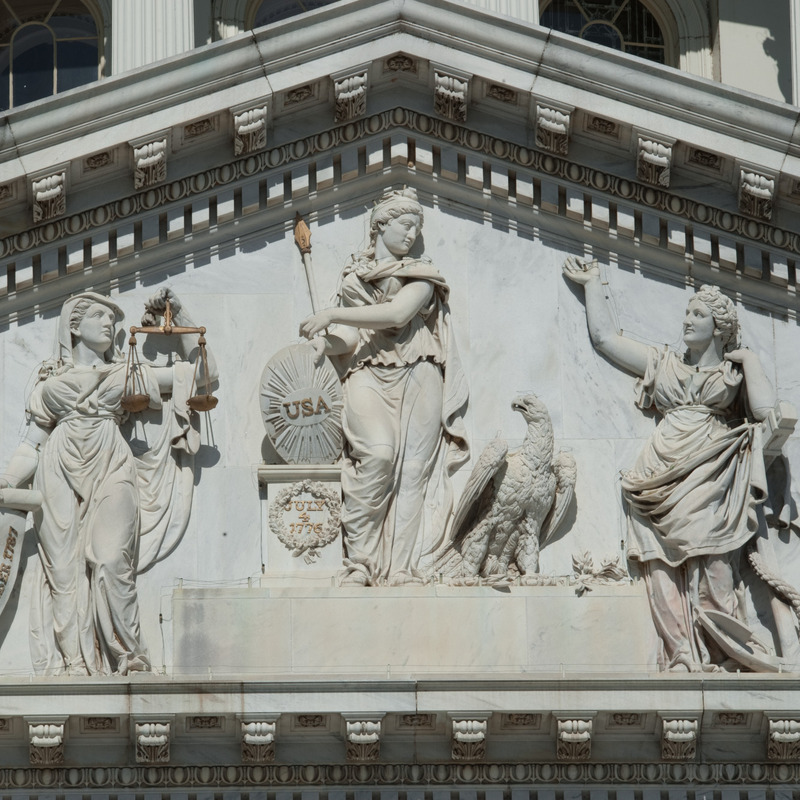
A pediment on the US Capitol, made of sandstone, it is 81.5 feet in length and 9 feet high. It shows justice with her scales holding the constitution, hope leaning on an anchor, and America resting her right arm on a shield inscribed USA. Next to America stands an eagle. The design relied heavily on the suggestions of President John Quincy Adams. Reproductions were made in marble by Bruno Mankowski by 1962.
George Washington Memorial
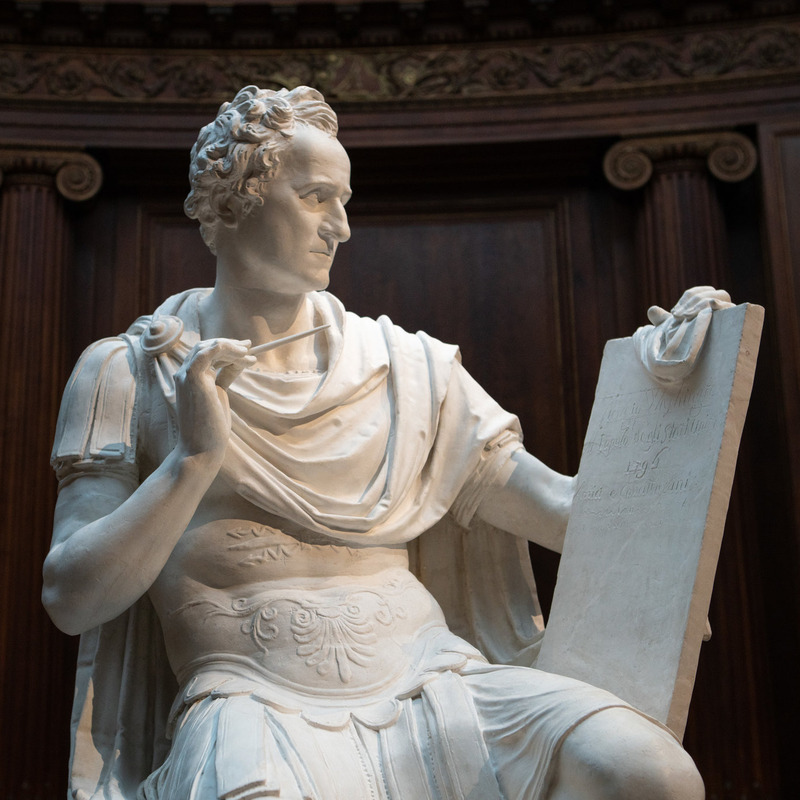
Commissioned on recommendation of Thomas Jefferson by Gov. William Miller, the statue used the marble bust created by Giuseppe "Joseph" Ceracchi as a model and created the form out of Carrara marble. Washing ton is dressed in ancient Roman military armor and is holding a tablet and quill with a sword at their feet. There was an inscription in both english and italian on the base with Washington's name and it says "To the Great Nation of the United States of America. A marble replica was made in 1970 by Romano Vio to replace the plaster copy the Italian government sent in 1910.
Christopher Columbus Monument
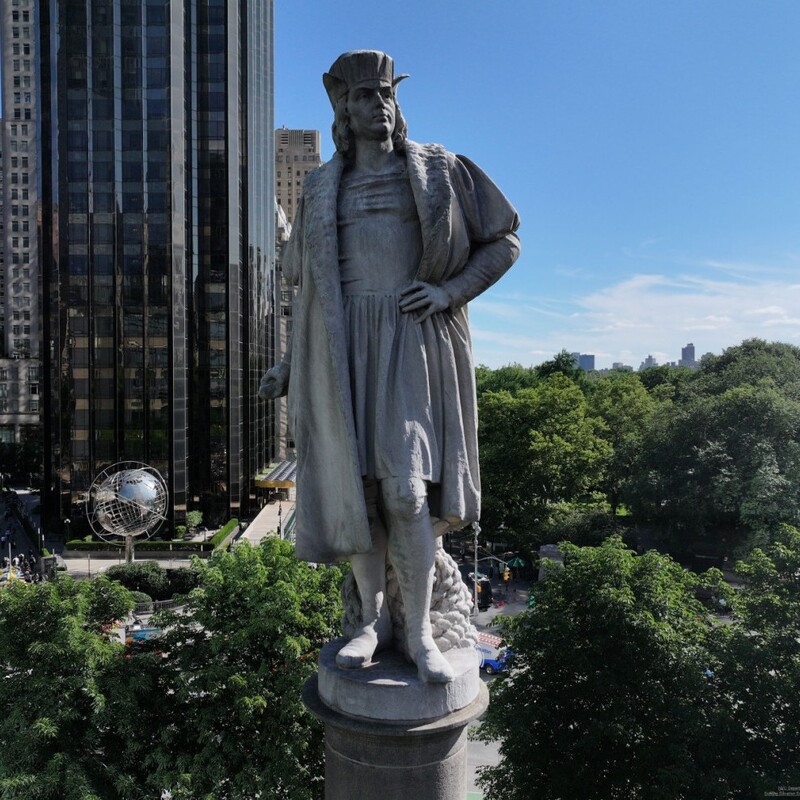
The pedestal consists of a square block of granite featuring octagonal pilasters at each corner. Attached to two sides are bronze bas-reliefs; one depicts Columbus departing in a boat towards land recently sighted, and the other portrays the explorer setting foot on the newly discovered territory. Atop the pedestal is a square-paneled pediment, on two sides of which are inscribed texts in English and Italian respectively, extolling Columbus and detailing the provenance of the monument. Additionally, the base bears a marble sculpture referred to as the Genius of Columbus, a marble sculpture of a male angel examining a globe, and an Alpine Eagle, also crafted from marble. Against the remaining two sides of the pediment are allegorical figures, and emerging from it is a colossal granite rostral column, which is characterized by ships sailing through it, approximately 27 feet in height and 6 feet in diameter. This supports the figure of Columbus, carved from pure white Carrara marble, measuring 13 feet in height.
Monument to Giuseppe Verdi
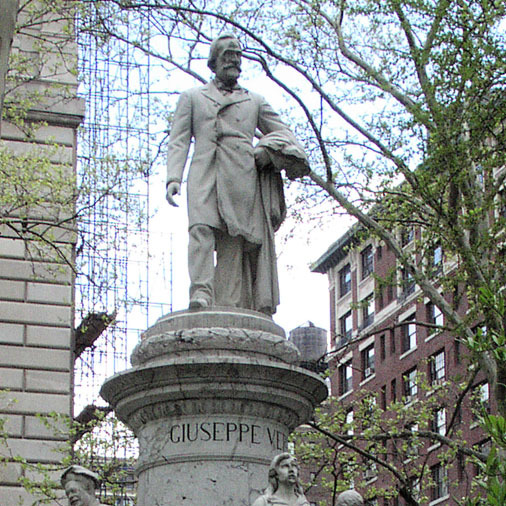
The statue of the Italian composer Giuseppe Verdi, crafted from white Carrara marble, depicts Verdi dressed in conventional 19th-century attire and is positioned on a pedestal measuring fifteen feet in height. At each of its four corners are life-size marble statues representing the principal characters from four of Verdi's operas: "Aida," "Falstaff," "Otello," and "Forza del Destino." The pedestal is constructed from dark granite. An inscription on the face of the pedestal reads: "Erected by the Italian community through the efforts of Chev. C. Barsotti, editor of the Italian daily newspaper, Il Progresso Italo Americano, October 12, 1906."
Browse all
Prev Next