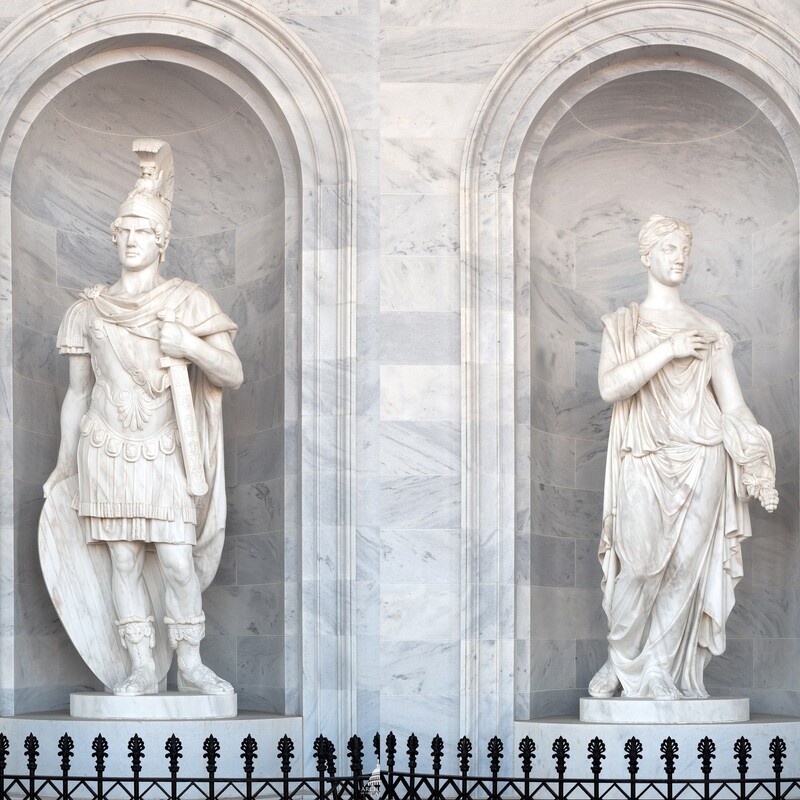
"War" is a male figure with his head slightly tilted and his gaze fixed ahead. His left hand holds the hilt of his sheathed sword and his right supports his shield as it rests upon the ground. He wears the costume of an ancient Roman, with a toga over his shoulders and a tunic extending as low as his knees; its border, like his belt, is richly ornamented. "Peace" is a female figure to the left of "War" dressed in simple, flowing robes with sandaled feet. In her left hand, she holds a fruit-bearing branch of the olive, which she extends towards "War," while with her right hand she points gracefully to her bosom. Original marbles were replaced in 1960 due to deterioration created by Paul Manship while the originals were repaired by Carl Schmitz.
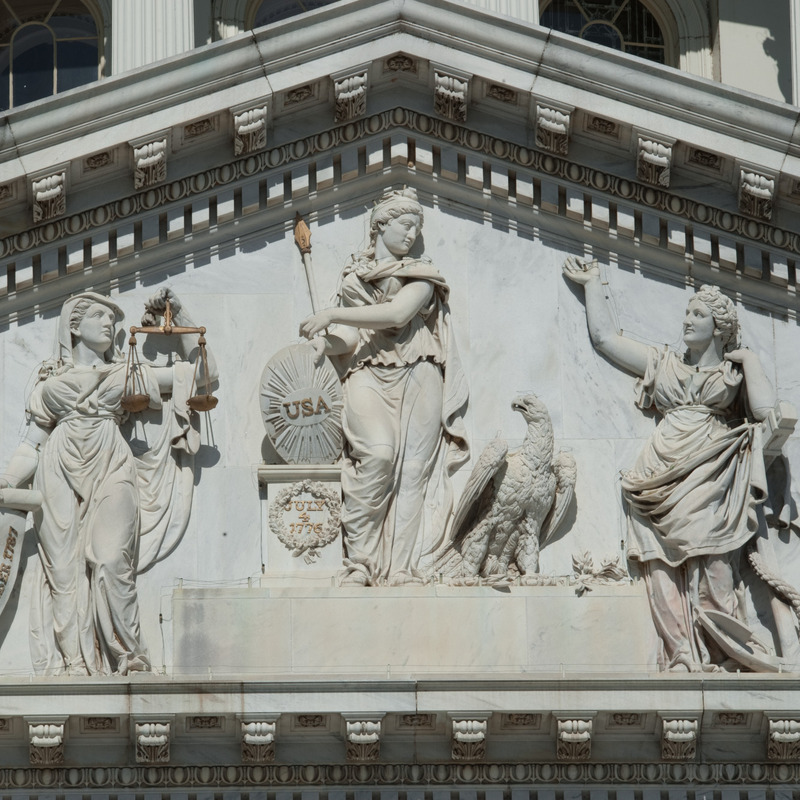
A pediment on the US Capitol, made of sandstone, it is 81.5 feet in length and 9 feet high. It shows justice with her scales holding the constitution, hope leaning on an anchor, and America resting her right arm on a shield inscribed USA. Next to America stands an eagle. The design relied heavily on the suggestions of President John Quincy Adams. Reproductions were made in marble by Bruno Mankowski by 1962.
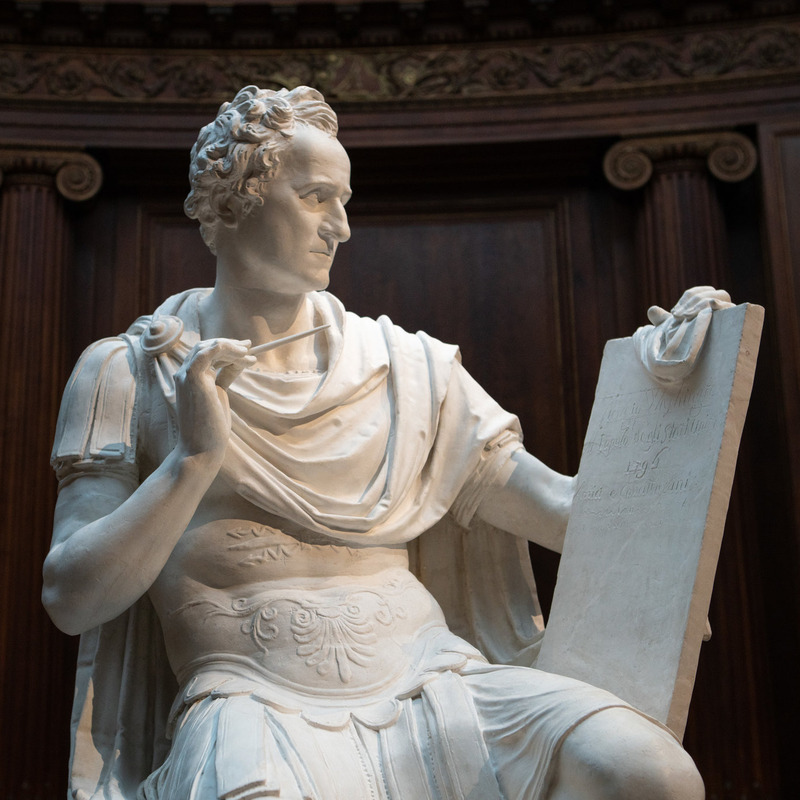
Commissioned on recommendation of Thomas Jefferson by Gov. William Miller, the statue used the marble bust created by Giuseppe "Joseph" Ceracchi as a model and created the form out of Carrara marble. Washing ton is dressed in ancient Roman military armor and is holding a tablet and quill with a sword at their feet. There was an inscription in both english and italian on the base with Washington's name and it says "To the Great Nation of the United States of America. A marble replica was made in 1970 by Romano Vio to replace the plaster copy the Italian government sent in 1910.
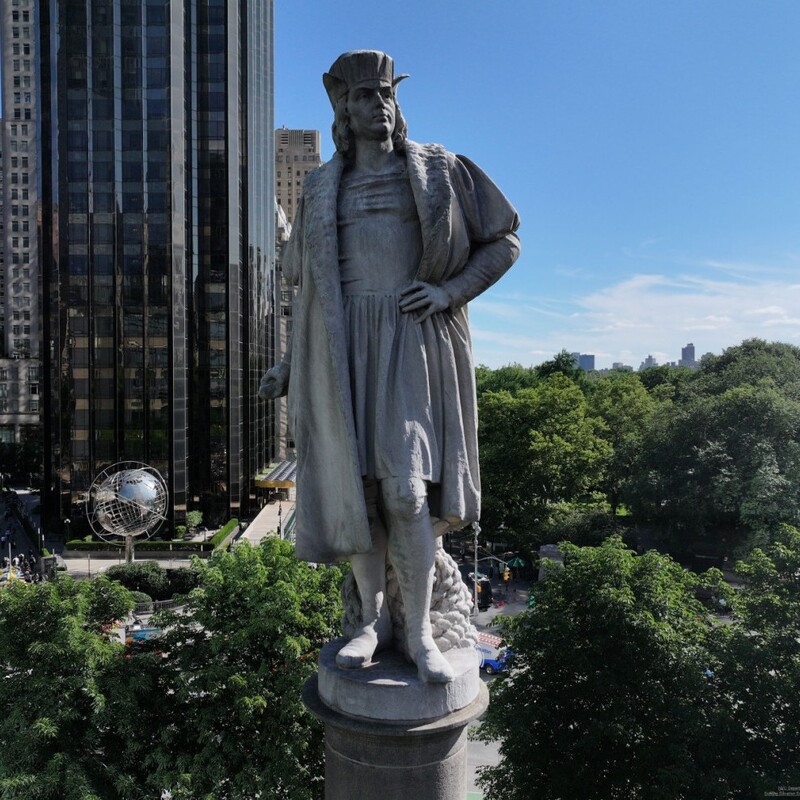
The pedestal consists of a square block of granite featuring octagonal pilasters at each corner. Attached to two sides are bronze bas-reliefs; one depicts Columbus departing in a boat towards land recently sighted, and the other portrays the explorer setting foot on the newly discovered territory. Atop the pedestal is a square-paneled pediment, on two sides of which are inscribed texts in English and Italian respectively, extolling Columbus and detailing the provenance of the monument. Additionally, the base bears a marble sculpture referred to as the Genius of Columbus, a marble sculpture of a male angel examining a globe, and an Alpine Eagle, also crafted from marble. Against the remaining two sides of the pediment are allegorical figures, and emerging from it is a colossal granite rostral column, which is characterized by ships sailing through it, approximately 27 feet in height and 6 feet in diameter. This supports the figure of Columbus, carved from pure white Carrara marble, measuring 13 feet in height.
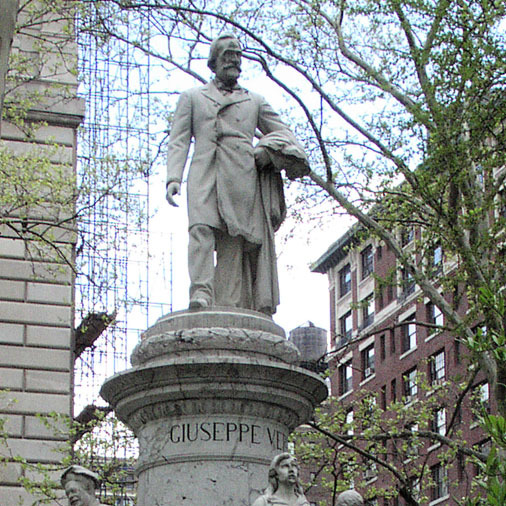
The statue of the Italian composer Giuseppe Verdi, crafted from white Carrara marble, depicts Verdi dressed in conventional 19th-century attire and is positioned on a pedestal measuring fifteen feet in height. At each of its four corners are life-size marble statues representing the principal characters from four of Verdi's operas: "Aida," "Falstaff," "Otello," and "Forza del Destino." The pedestal is constructed from dark granite. An inscription on the face of the pedestal reads: "Erected by the Italian community through the efforts of Chev. C. Barsotti, editor of the Italian daily newspaper, Il Progresso Italo Americano, October 12, 1906."